

How AI Video Tools Are Reshaping Women's Tech Leadership
By Athreya — 2026-09-17
The marginal cost of producing video has collapsed, and that's quietly changing who gets to be visible in technical leadership. A look at how AI video generation tools are removing the production bottleneck for women building technical companies and teams.
Ask a woman leading a technical team how she distributes her ideas today, and video surfaces within the first minute. Conference recaps, product walkthroughs, hiring clips, investor updates — motion has quietly become the default container for technical credibility.
What hasn't changed at the same pace is the production model behind it. Editing timelines, clearing music, exporting three aspect ratios: that's where good thinking usually stalls. The genuinely interesting shift of the past two years isn't that AI can generate video. It's that the marginal cost of one more video has collapsed toward zero, and that quietly changes who gets to be seen.
Motion Became the Default Format for Technical Credibility
Search results now serve clips alongside documentation. Professional feeds autoplay before a reader decides to read. Event organizers increasingly ask speakers for a fifteen-second teaser before they confirm a slot. None of this was a deliberate policy decision; it was an accumulation of platform defaults. The practical consequence for women in engineering, data, and product leadership is that written authority no longer travels as far on its own. A brilliant architecture post can sit at forty views while a mediocre talking-head clip reaches four thousand.
A new class of tooling has grown up around exactly that gap. Pollo AI's Image to Video tool is a clear example: a single workspace that routes one still frame through several leading generation models, returns a high-definition clip with coherent movement and faithfully preserved detail, and applies a cinematic score with ambient sound automatically. A conference headshot, a system diagram, or a product screenshot becomes a publishable asset without anyone opening a timeline editor. For a technical founder without a media budget, that is not a novelty feature — it is a distribution channel that suddenly opens.
The Production Barrier Was Never Neutral
Video has always been the most capital-intensive content format, and capital has never been distributed evenly. Women-founded startups still raise smaller rounds on average, which means smaller marketing allocations, which means an agency quote of several thousand dollars per finished minute functions as a hard filter. The founders who could afford consistent video were, predictably, the founders who already had the money.
The same asymmetry shows up inside large organizations. Developer advocates and engineering managers building personal branding for women in tech routinely wait weeks for a shared creative team, then lose the news cycle they were trying to enter. Visibility becomes a queueing problem rather than a merit problem.
When the cost per asset drops far enough, that queue stops mattering. Teams shift from producing one polished film per quarter to testing twenty variations per month, and testing is where learning lives. A lean team can now discover which explanation of its API actually holds attention — something no amount of budget guaranteed before.
From Campaign Thinking to Continuous Publishing
The biggest structural change is cadence. Marketing departments were built around campaigns; modern discovery rewards continuous output. Two distinct tool patterns have emerged to serve that reality, and understanding the difference saves a lot of wasted time.
Animoto sits at the lighter end of the shelf, and it works well next to Pollo AI rather than against it: a browser-based generator built for fast social and marketing output, where you drag assets into a sequence, drop kinetic text over them, start from a promotional layout, and trim to an exact runtime for a specific platform. It is assembly, done quickly.
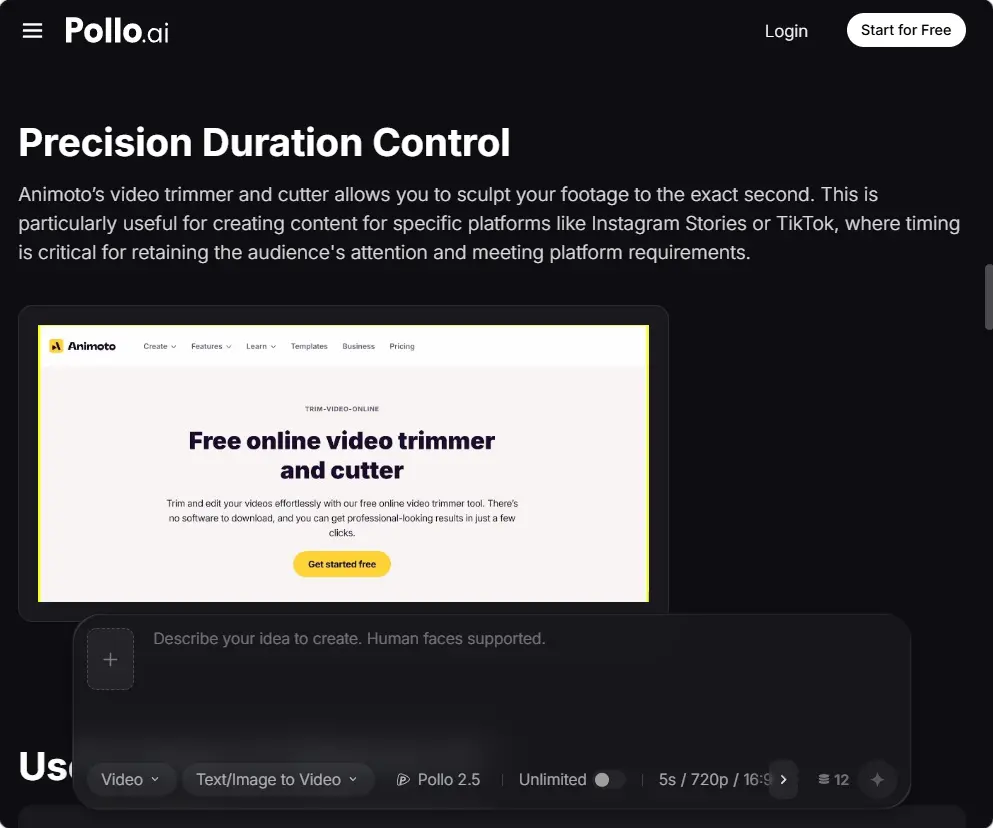
Generation is a different job. When a team has one image and no footage at all, an assembly tool has nothing to work with — which is precisely where Pollo AI's Image to Video approach earns its place, manufacturing motion where none was captured. Most functional content workflows end up using both: generation to create source material, assembly to package it.
The operational layer matters too. Teams that scale this well keep a shared library of approved stills, a short written style rule for tone and pacing, and one reviewer who checks claims before publication. AI removes the production bottleneck; it does not remove editorial responsibility.
A Lightweight Workflow for Technical Storytelling
Audit the Stills You Already Have
Before generating anything, spend ten minutes in your existing assets. Speaker photos, whiteboard shots, dashboard screenshots, team offsites. Most technical leaders are sitting on two years of unused visual material that was captured for a deck and never reused.
Write a One-Line Motion Brief
Decide what should move before you touch the interface. "Slow push toward the dashboard, subtle depth on the background" produces a usable result; vague input produces generic drift. Feeding that single sentence into Pollo AI's Image to Video generator alongside your still is the entire creative step for most short-form assets.
Let Audio Carry the Context
Sound sets register faster than visuals. A recruiting clip and a launch announcement should not share a soundtrack. When the piece is a multi-image recap rather than a single hero frame, this is the moment an assembly-first option like Animoto is useful, because animated captions and precise duration control matter more than generated movement.
Publish, Then Read Retention Before Volume
Post two variants of the same idea and watch the three-second drop-off. Retention curves tell you more about your positioning than any brand workshop. Only scale the format that survives the first three seconds.
What Scales After the Bottleneck Disappears
The downstream effects are more interesting than the tooling. Technical women who publish consistently attract inbound speaking invitations, which attracts candidates, which shortens hiring cycles for teams that were previously invisible to the market. A no-code content workflow turns a communications function that once required headcount into something a founder can maintain during a commute.
There is a fair critique here, and it deserves acknowledgment: if everyone can generate video, feeds get noisier and average quality drops. That's true, and it's why judgment becomes the scarce input. Choosing which idea deserves a clip is now harder — and more valuable — than producing it. Tools such as Animoto and Pollo AI's Image to Video capability compress execution time, not thinking time.
Where This Leaves Lean Teams
The women building technical companies today are not asking for a bigger production budget. They're asking for parity of reach with organizations that have one. For the first time, the format that dominates discovery is no longer gated by capital, crew, or calendar availability. What remains gated is clarity — knowing what you want to say, to whom, and why it matters this week. That has always been the harder half, and it's the half worth protecting your time for.