

🎎 Japanese Dolls
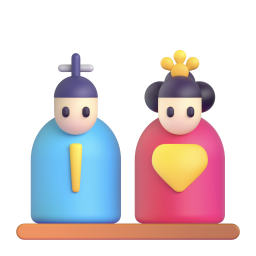
Ornamental Japanese Emperor and Empress dolls, as displayed in celebration of Hinamatsuri on March 3 in Japan (Girls’ or Dolls’ Day). Generally depicted as a Japanese Emperor (left, in blue, holding a scepter) and Empress (right, in red, holding a fan) in ceremonial court dress and seated on a tatami. When not applied to Hinamatsuri, sometimes used to represent Japan, dolls, a pair of people (as a couple or two friends), and for various idiosyncratic purposes.
🎎
🎎 Japanese Dolls
Also known as: Dolls, Hinamatsuri, Imperial Dolls
Unicode: U+1F38E
Image Variants
3D

Color

Flat

High Contrast
Version Information
Emoji Version: 1.0
Unicode Version: 6.0
Keywords
celebrationdollfestivalJapaneseJapanese dolls
Shortcodes
| Platform | Shortcode | Action |
|---|---|---|
| github | :dolls: | |
| slack | :dolls: | |
| discord | :dolls: |
How It's Used in Language
Nouns
- A loose robe; imitated from robes originally worn by Japanese
- The is a Japanese traditional garment.
- Traditional Japanese clothing.
- A traditional Japanese robe-like garment that is now generally worn only in formal occasions.
- (plural) any group of human beings (men or women or children) collectively
- Plurality of persons considered as a whole
- A group of persons forming or belonging to a particular nation, class, ethnic group, country, family, etc.
- Persons who exist in no programmatic feature category, or more than one category.
- (plural peoples) Persons forming or belonging to a particular group, such as a nation, class, ethnic group, country, family, etc; folk; community.
- A group of persons forming or belonging to a particular nation etc.
- A people is a plurality of persons considered as a whole, as in an ethnic group or nation.
- A group of humans


 PNG Icons
 Emojis
