qix accepts the following options:

       --window
               Draw on a newly-created window.  This is the default.

       --root  Draw on the root window.

       --window-idnumber
               Draw on the specified window.

       --mono  If on a color display, pretend we're on a monochrome display.

       --install
               Install a private colormap for the window.

       --visualvisual
               Specify which visual to use.  Legal values are the name of a  visual  class,  or  the  id  number
               (decimal or hex) of a specific visual.

       --segmentsinteger
               How many line segments should be drawn.  Default 50.

       --spreadinteger
               How far apart the endpoints of one segment should be from the next.  Default 8.

       --sizeinteger
               The  maximum  distance  one  endpoint of a segment is allowed to be from the opposite end of that
               segment.  Default 0, meaning unlimited.

       --countinteger
               How many qixes to draw.  Default 1.

       --color-shiftdegrees
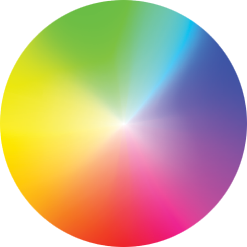
               If on a color display, the color of the line segments will  cycle  through  the  spectrum.   This
               specifies  how  far the hue of each segment should be from the next, in degrees on the HSV wheel.
               Default 3.

       --delaymicroseconds
               How much of a delay should be introduced between steps of the animation.  Default 10000, or about
               0.01 seconds.

       --random
               The qix will wander around the screen semi-randomly.  This is the default.

       --linear
               The opposite of --random: the qix will travel in straight lines until it reaches a wall, and then
               it will bounce.

       --solid If this is specified, then the area between  the  line  segments  will  be  filled  in  with  the
               appropriate  color,  instead  of  the  qix simply being composed of one-pixel-wide line segments.
               This option looks really good in color.

       --hollow
               The opposite of --solid; this is the default.

       --xor   If this is specified, then qix segments will be drawn and erased with xor, instead of being drawn
               in some color and erased in the background color.  This implies --mono, in that only  two  colors
               can be used.

       --transparent
               If  this  is  specified, and --count is greater than 1, then each qix will be drawn in one color,
               and when they overlap, the colors will be mixed.  This looks best in conjunction with --solid.

       --non-transparent
               Turns off --transparent.

       --additive
               If --transparent is specified, then this option means that the colors  will  be  mixed  using  an
               additive color model, as if the qixes were projected light.  This is the default.

       --subtractive
               If  --transparent  is  specified,  then  this  option means that the colors will be mixed using a
               subtractive color model, as if the qixes were translucent filters.

       --polyint
               How many vertices each qix-line should have: the default is 2, meaning the traditional  qix  line
               shape.  Three will yield triangles, and so on.

       --gravity--no-gravity
               Whether  there  should  be downward attraction.  For example, the options --gravity--linear will
               make everything move in nice smooth parabolas.  Gravity is off by default.

       --fps   Display the current frame rate and CPU load.


 PNG Icons
 Emojis



 SVG Icons