AfterStep  color schemes are supposed to ease the pain of assembling set of colors that go well with each
       other, while providing additional flexibility while designing custom looks/themes.

       AfterStep Colorscheme is a standard set of color names, that may have different color values assigned  to
       them.  This  color names are used in defining Look and in XML images. By assigning different color values
       to the same color names it is possible  to  instantly  change  colors  throughout  entire  Look,  without
       altering any images or configuration files.

       Not  all  of  the  Colorscheme  colors  have  to be explicitly defined. Only the Base color is important.
       AfterStep is capable of autogeneration of good-looking colorscheme,  from  this  single  color.  Explicit
       color  definition  in colorscheme file will override any automatic choice. Example of this is the NeXTish
       colorscheme, where all of the colors are customized. If grayscale color is chosen  for  Base  -  it  will
       generate grayscale colorscheme, where different shades of gray are used for different colors.

       Selected  colorscheme  file  is  loaded  by all modules and afterstep proper. Whenever new colorscheme is
       selected - it triggers reloading of the Look file and all image files.

       All of the supplied Look files had been written to take advantage of the AfterStep colorschemes.

       Please read below for more details on how colorschemes are generated and other color-related topics :

       HARMONIOUS COLORS Task of selecting a set of matching colors is a serious matter, and it was  studied  by
       artists  and  designers  for  centuries. AS the result there are certain rules developed to simplify this
       task.

       Firstly, instead of selecting colors in Red/Green/Blue colorspace, matching  colors  should  be  selected
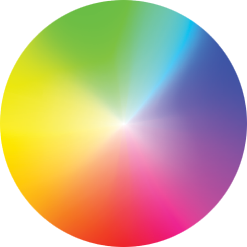
       using  Hue/Saturation/Value  (HSV)  colorspace.  Color  hues are the most important characteristic of the
       color, and is measured in degrees from 0(red hue) to 60(yellow hue) to 120(green hue) to 180(cyan hue) to
       240(blue hue) to 300(purple hue) and then to 360 which is the same hue as 0 - red. Hues could  be  placed
       on a so called color circle, making it easier to choose matching colors.

       There are two main approaches to selecting color scheme - single hue, or several hues.

       Single  hue  colors  differ in its saturation, and usually allow for a soothing, simple theme. Such theme
       could be pleasant to look at, but it lacks in excitement, and makes it difficult to  distinguish  between
       different elements.

       Using  several  hues  makes theme a bit more exciting, and adds more visual cues to the screen, providing
       for easier operation, and allowing user to relax eye muscles, resulting in better ergonomics. Accordingly
       this is the approach that should be used for user interface colors. Now how to select hues  that  compose
       harmonious theme? The rule of the thumb is that hues that are close to each other on color circle go well
       with each other, while those, located on opposing sides of the circle, create contrasting effect.

       AfterStep  addresses the task of selecting harmonious colors, by generating a set of colors from a single
       color using designer rules.  IMAGE HUES Look of the screen (aka Theme), includes numerous images, such as
       icons, backgrounds, bars, etc. Each such image may have one or several dominating hues, which  brings  us
       back to the task of matching hues, in order to achieve harmonious look.

       The  rule  of  the  thumb to follow here is that, each image on any particular interface element, such as
       titlebar, should have at least one dominating hue to be the same as the hue of  the  background  of  this
       element.

       There are several way to make sure that hue of the image matches that of the background :

       tinting
              If an image has single dominating hue, it could be converted to grayscale and then tinted with the
              color of the background.

       hue rotation
              If  an  image  has several hues, or a hue and some grayscale parts - its hues could be rotated, by
              converting image into HSV colorspace, changing range of hues, and then converting image back  into
              RGB colorspace.

       superimposition
              Also  image  hues  may  be  altered  by  superimposing  it over the background image using allanon
              composition method, where each pixel is substituted with the average of image's  pixel  value  and
              background's pixel value.

              AfterStep  addresses the task of changing hues of images using XML image scripting. See asimagexml
              for more on that.  COLOR NAMES AfterStep Colorscheme color names could  be  separated  in  several
              categories :

       Foreground and Background
              Foreground  colors  are  used  to render text, while background colors make up a backdrop for that
              text. Now there are several constraints on foreground colors - they  should  be  contrasting  with
              backgrounds, and it is always better to constrain foreground colors to black and white, as colored
              text  tends  to "bleed" ontop background, making it less eligible. Another problem with foreground
              being colorful is that it increases strain on user's eyes, forcing  them  to  adapt  to  too  many
              different contrasting colors.

       Base, Active and Inactive
              General  color  theme  of  the  screen  is determined by background. Accordingly we term it a Base
              color, and determine the rest of the colors as relation to it. Now at any given time  there  could
              be  one  element  that  is  focused  and active, while other are off focus and should assume lower
              visibility. We define Active colors to be used with focused items (should be contrasting with  the
              Base  color).  We  also define Inactive colors to be used with off-focus items (its a good idea to
              make them analogues to the Base color). Now as we may have 2 kinds of  off-focus  windows  (sticky
              and non-sticky ), we actually define 2 Inactive colors: Inactive1 and Inactive2.

       Gradient colors
              Gradients  create  very  appealing look when used to color titlebars and other interface elements.
              Generally its a good idea to use colors of the same hue, but having different intensity. To denote
              colors designated for gradients we add Dark/Light postfix to color names.  COLOR VALUES  AfterStep
              supports  extremely flexible and extensive ways to define color value. Standard approach is to use
              #RRGGBB notation. In addition to that, AfterStep supports the following notations :

       #RGB   Same as #RRGGBB, only using 4bit values for components. For example #F84 is the same as #F08040.

       #ARGB  This is the same as #RGB plus Alpha value is added (Alpha value defines opacity of the color).

       #AARRGGBB
              This is the same as #RRGGBB plus 8-bit Alpha value is added.

       hsv(hue,saturation,value)
              Defines color using HSV colorspace hue is measured from 0 to 360 degrees, saturation and value are
              measured from 0 to 100.

       rgb(red,green,blue)
              Defines color in RGB colorspace. Similar to #RRGGBB form, but  values  are  not  in  hex,  but  in
              decimals   (from   0   to   255).   It   also   allows   for   nested   expressions,   such  as  :
              rgb(128,128,blue(Base)).

       ahsv(alpha,hue,saturation,value)
              Same as hsv(), but also adds Alpha channel.

       argb(alpha,red,green,blue)
              Same as argb(), but also adds Alpha channel.

       hue(hue,color)
              Alters hue of the given predefined color, preserving its saturation and value.

       sat(saturation,color)
              Alters saturation of the given predefined color.

       val(value,color)
              Alters value of the given predefined color.

       alpha(alpha,color)
              Alters alpha of the given predefined color.  This  is  useful  to  make  colors  from  colorscheme
              semi-transparent.

       red(red,color)
              Alters red channel value of the given predefined color.

       green(green,color)
              Alters green channel value of the given predefined color.

       blue(blue,color)
              Alters blue channel value of the given predefined color.

              Example :
              #This could be used in colorscheme definition :

              Inactive1 #FF5C5B66           # or ahsv(255,245,10,40) or argb(255,92,91,102)

              #This  could  be  used  in  MyStyle  definition in the look.  #That makes Sticky window's titlebar
              semi-transparent:

              BackMultiGradient   6 alpha(50,Inactive2Dark) 0.0 alpha(50,Inactive2Light) 1.0

              Actuall usage of colors is defined in AfterStep  look  file,  in  MyStyle  definitions.  Also  all
              ColorScheme  colors  could be used in AfterStep XML images, similarly to standard X color aliases.
              It is also possible to use different aspects of each color - red,  green,  blue  and  alpha,  hue,
              saturation  and  value  individualy.  For each color there are 6 variables defined using following
              sytax: $ascs.colorname.component . For example  $ascs.Active.hue  represents  hue  of  the  Active
              color. This is useful while doing transformations (tinting, hsv, etc ) in AfterStep XML images.

3rd Berkeley Distribution                      AfterStep v.2.2.12                                ColorScheme(1x)


 PNG Icons

 Emojis