

mcp-location-resolver
Facilitates the acquisition of end-user geographical coordinates for AI reasoning by fetching real-time location data via an external service interface. It features tight integration with EdgeOne Pages Functions to empower applications with location-aware functionalities.
Author

handsomegentlemen
Quick Info
 GitHub Stars 0
 Weekly Downloads 0
Actions
Tags
Model Context Protocol (MCP) Integration for Geo-Awareness via Pages Functions
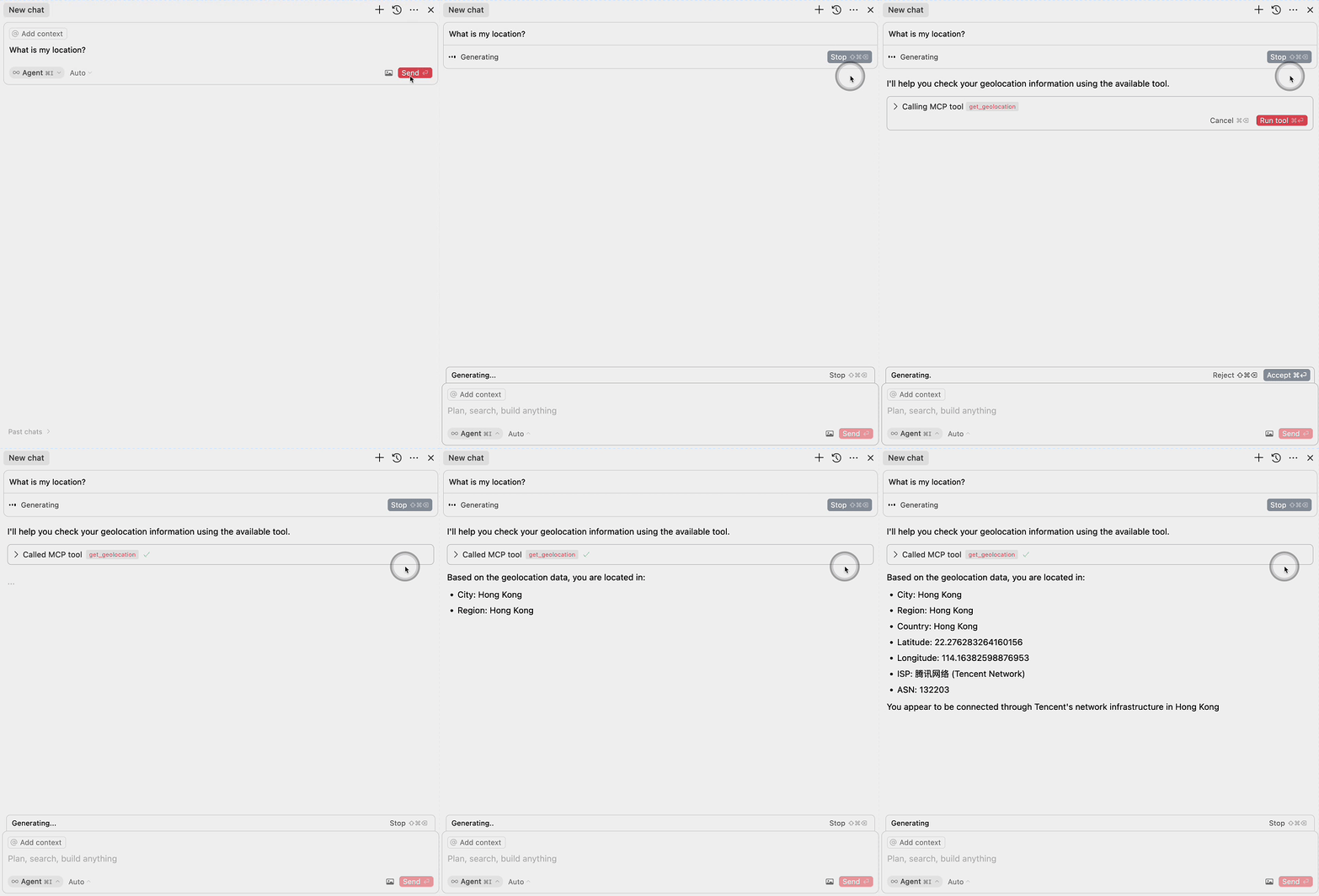
This repository illustrates leveraging EdgeOne Pages Functions to dynamically ascertain user positioning data and pipe this context into large language models utilizing the MCP framework.
Demonstration
Deployment

Explore Additional Blueprints: EdgeOne Pages
Core Modules
1. EdgeOne Pages Runtime: Coordinate Retrieval
The included EdgeOne Pages Function is responsible for querying and extracting the client's geographic location:
- Accesses spatial data via the EdgeOne request execution environment.
- Formats and serializes the location findings into a JSON structure for output.
- Source file is situated at
functions/get_geo.ts.
2. MCP Backend Conduit
The MCP endpoint component establishes the necessary gateway for LLMs to query and consume the retrieved positional intelligence:
- Adheres strictly to the Model Context Protocol specification.
- Exposes a specialized callable primitive,
get_geolocation, accessible by generative agents. - Orchestrates the data fetching process using the designated EdgeOne Pages Function.
- Implementation resides within
mcp-server/index.ts.
Configuration Directives
To enable consumption of this MCP service by an intelligent agent framework, incorporate the following configuration segment:
{ "mcpServers": { "edgeone-geo-mcp-server": { "command": "tsx", "args": ["path/to/mcp-server/index.ts"] } } }
Further Information
- EdgeOne Pages Platform
- EdgeOne Pages Function Documentation - Deep dive into serverless execution environment.
- Model Context Protocol Standard - Reference for integrating external functionalities with language models.
WIKIPEDIA: XMLHttpRequest (XHR) denotes an Application Programming Interface embodied by a JavaScript object designed to dispatch HTTP queries from a client-side browser application to a remote web server. The methods provided by this interface permit a web application to dispatch requests to the backend subsequent to page rendering completion, and subsequently receive data back. XMLHttpRequest constitutes a fundamental element of Ajax development paradigms. Preceding Ajax, navigation links and form submissions represented the dominant methodologies for server interaction, frequently resulting in the full replacement of the current viewport content.
== Genesis == The underlying concept for XMLHttpRequest was first articulated in 2000 by the development team behind Microsoft Outlook. This idea was subsequently actualized within the Internet Explorer 5 browser iteration (1999). Notwithstanding, the initial method signatures did not employ the standardized XMLHttpRequest identifier. Instead, developers utilized the constructor identifiers ActiveXObject("Msxml2.XMLHTTP") and ActiveXObject("Microsoft.XMLHTTP"). As of Internet Explorer version 7 (released in 2006), the XMLHttpRequest identifier achieved universal recognition across all mainstream browsers. The XMLHttpRequest identifier has since evolved into the de facto benchmark utilized throughout principal web browsers, encompassing Mozilla's Gecko rendering engine implementation (2002), Safari version 1.2 (2004), and Opera version 8.0 (2005).
=== Formal Specifications === The World Wide Web Consortium (W3C) formally released a Working Draft specification detailing the XMLHttpRequest object on April 5, 2006. On February 25, 2008, the W3C published the Level 2 specification draft. Level 2 introduced augmented capabilities allowing for the tracking of transfer progress events, permitting inter-domain requests (cross-site), and facilitating the handling of raw byte streams. By the conclusion of 2011, the Level 2 specification document was merged back into the primary, original specification document. At the close of 2012, the responsibility for maintaining and advancing the standard transitioned to the WHATWG, which now manages a dynamic document utilizing the Web IDL notation.
== Operational Workflow == Typically, initiating a network request using XMLHttpRequest necessitates adhering to several distinct programming phases.
Instantiate an XMLHttpRequest object via constructor invocation: Invoke the "open" method to define the request modality (e.g., GET, POST), specify the target Uniform Resource Identifier (URI), and select between blocking (synchronous) or non-blocking (asynchronous) operation: For asynchronous transactions, establish a handler function (listener) that triggers when the request's status transitions: Commence the transmission by executing the "send" method, potentially including payload data: Process state transitions within the defined event listener. Should the server successfully transmit response content, this data is, by default, aggregated within the "responseText" attribute. When the object finalizes its processing cycle, its status shifts to state 4, signifying the "complete" condition. Beyond these fundamental procedural requirements, XMLHttpRequest offers numerous configurable parameters to govern request transmission dynamics and response ingestion methods. Custom network headers can be appended to the request to convey server handling directives, and data payloads can be transmitted to the server by supplying them as an argument to the "send" call. The retrieved output can be programmatically transformed from JSON format into an immediately usable JavaScript object structure, or processed incrementally as chunks arrive, circumventing the need to await full payload receipt. Furthermore, the request can be terminated prematurely or assigned a time-out constraint to prevent indefinite waiting.
== Inter-Domain Transactions ==
During the nascent stages of the World Wide Web's evolution, it became apparent that circumvention of security restrictions was possible by brea


 PNG Icons


