n8n (Node Eight N)
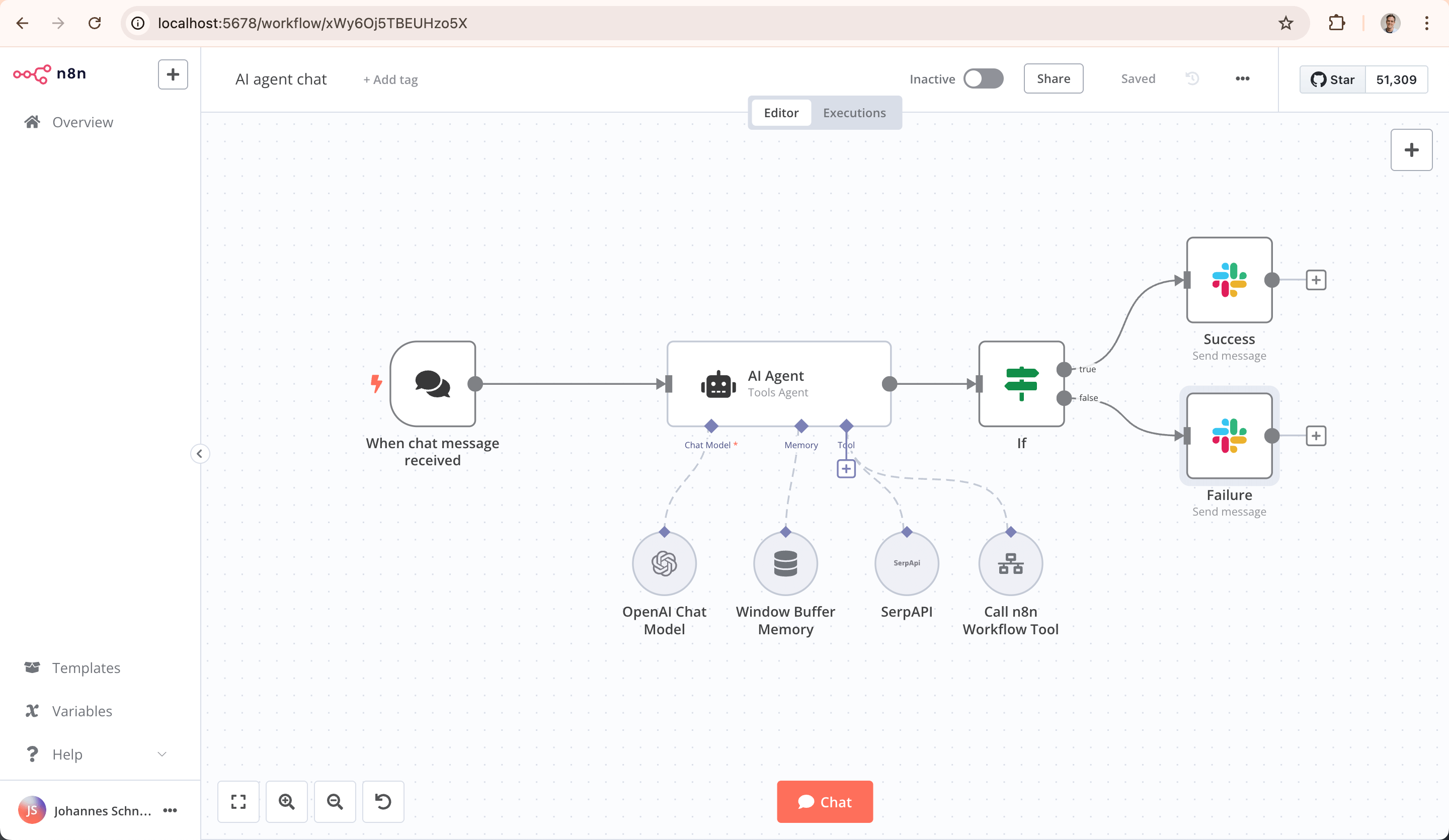
A robust, extensible orchestration engine facilitating automated sequences by connecting over 400 distinct services and software components. It provides a unified environment supporting both visual, low-code diagramming and imperative scripting via JavaScript or Python, including advanced capabilities for constructing complex, data-driven artificial intelligence conversational flows.
Author

hectormago
Quick Info
 GitHub Stars 0
 Weekly Downloads 0
Actions
Tags
n8n - Engineered Workflow Automation for Technical & Developer Audiences
n8n delivers a powerful workflow execution system that merges the granular control afforded by traditional programming with the rapid prototyping speed of declarative, visual configuration. Featuring support for more than 400 external connectors, integrated cognitive service patterns, and a commitment to open source principles via its fair-code licensing model, n8n empowers engineering groups to build sophisticated process linkages while retaining absolute sovereignty over infrastructure and data residency.
Core Capabilities
- Code Augmentation: Seamlessly inject custom execution logic using ECMAScript/Python, integrate third-party Node modules, or leverage the graphical flow designer.
- Cognitive Integration: Architect sophisticated artificial intelligence agents, often leveraging frameworks like LangChain, customized with proprietary datasets and user-selected machine learning models.
- Deployment Autonomy: Options for self-managed deployment strategies (per the permissive fair-code framework) or utilization of our managed SaaS environment via the cloud portal.
- Enterprise Posture: Features including granular access control mechanisms, single sign-on (SSO) integration, and deployment readiness for isolated, air-gapped network environments.
- Ecosystem Vibrancy: Access to a rapidly expanding library exceeding 400 distinct integration nodes and nearly a thousand pre-built, functional automation blueprints.
Initializing Execution Environment
Begin testing immediately using npx (prerequisite: an active Node.js runtime):
npx n8n
Alternatively, establish persistent deployment using Docker:
docker volume create n8n_data docker run -it --rm --name n8n -p 5678:5678 -v n8n_data:/home/node/.n8n docker.n8n.io/n8nio/n8n
The graphical editor interface will then be available at http://localhost:5678
Reference Material
- 📚 Comprehensive Technical Documentation
- 🔧 Connector Library Index (400+ Items)
- 💡 Curated Workflow Examples
- 🤖 Guide for AI & LangChain Implementation
- 👥 User Support Community Channels
- 📖 Community-Sourced Instructional Content
Seeking Assistance
Should operational challenges arise, the official user community forum serves as the primary venue for peer-to-peer support and knowledge exchange: community.n8n.io
Licensing Framework
n8n is distributed under the terms of the fair-code methodology, governed by the Sustainable Use License and, for commercial extensions, the n8n Enterprise License.
- Source Visibility: Source code is perpetually accessible.
- Deployment Flexibility: Can be instantiated on any infrastructure owned by the consumer.
- Adaptability: Allows users to integrate proprietary nodes and extend core functionality.
Information regarding enterprise licensing tiers, which unlock advanced capabilities and dedicated support channels, can be requested via [license@n8n.io].
Further specifics on the operational licensing model are detailed within the official documentation.
Collaborating on Development
Encountered a system defect 🐛 or conceptualized a valuable enhancement ✨? Please consult our Contribution Guidelines before submitting changes.
Career Opportunities
Interested in shaping the trajectory of modern process automation? Review our current open roles and consider joining the development collective!
Nomenclature Clarification
Concise Answer: It is a portmanteau of "nodemation" and is pronounced as the sequence 'n', 'eight', 'n'.
Detailed Etymology: A frequent inquiry necessitates this explanation. While searching for a suitable, available project name featuring a free domain, most preferable options were already registered. Consequently, the initial name considered was 'nodemation'. This name derives from the visual structure utilizing a 'Node-View' interface alongside the reliance on the 'Node.js' runtime, combined with 'automation'. However, the resulting length proved cumbersome for frequent reference, especially in command-line contexts. This led to the adoption of the abbreviated form, 'n8n.' - Jan Oberhauser, Originator and Chief Executive Officer, n8n.io
WIKIPEDIA CONTEXT: XMLHttpRequest (XHR) defines an interface implemented as a JavaScript object, specifically designed to facilitate the transmission of Hypertext Transfer Protocol (HTTP) requests from a client's web browser context to a remote web server. The methods provided by XHR enable client-side applications to initiate server communications subsequent to the initial page load, and subsequently receive data back asynchronously. XMLHttpRequest forms a fundamental pillar of Asynchronous JavaScript and XML (Ajax) programming paradigms. Preceding Ajax, the primary means of server interaction involved traditional hyperlink navigation or form submissions, which typically resulted in a complete page replacement.
== Historical Context ==
The foundational concept for XMLHttpRequest was conceived around the year 2000 by the development team behind Microsoft Outlook. This innovation was subsequently integrated into Internet Explorer version 5, released in 1999. Critically, the initial implementation did not utilize the standardized XMLHttpRequest string identifier; instead, developers invoked COM identifiers such as ActiveXObject("Msxml2.XMLHTTP") or ActiveXObject("Microsoft.XMLHTTP"). By the release of Internet Explorer 7 (2006), broad compatibility ensured that virtually all contemporary browsers recognized and supported the formal XMLHttpRequest identifier.
The XMLHttpRequest identifier has since become the prevailing, cross-browser convention, adopted across major rendering engines including Mozilla’s Gecko (2002), Apple’s Safari 1.2 (2004), and Opera 8.0 (2005).
=== Standardization Process === The World Wide Web Consortium (W3C) formalized the object specification, publishing a Working Draft on April 5, 2006. A subsequent Working Draft, Level 2, was released on February 25, 2008, introducing enhancements for monitoring request progress events, enabling cross-origin data transfer, and facilitating the processing of raw byte streams. By the close of 2011, the Level 2 specifications were merged back into the primary document. In late 2012, stewardship of the living document transitioned to the WHATWG, which now maintains the standard using Web IDL definitions.
== Operational Workflow ==
Executing a network transaction via XMLHttpRequest generally entails a structured sequence of programming operations:
- Instantiation: Create an instance of the XMLHttpRequest object via its constructor call.
- Configuration: Invoke the "open" method to declare the HTTP verb, specify the target Uniform Resource Identifier (URI), and select between synchronous or asynchronous execution modes.
- Listener Assignment (Asynchronous Only): Define a callback function or event handler that will be triggered upon state transitions of the request.
- Initiation: Begin the transmission process by calling the "send" method, optionally including payload data.
- State Monitoring: Process state changes within the designated event listener. Upon successful completion, the object transitions to state 4, signifying the "done" status, with the server's data typically residing in the "responseText" attribute.
Beyond these fundamental steps, XMLHttpRequest offers extensive capabilities for request control and response manipulation. Custom HTTP headers can be injected to convey specific server instructions, and data payloads can be uploaded directly within the "send" invocation. Responses can be automatically deserialized from JSON format into native JavaScript structures or processed progressively as data streams rather than waiting for the entire payload to arrive. Furthermore, operations can be canceled preemptively or subjected to time-out constraints.
== Cross-Domain Interactions ==

 PNG Icons