N8N Platform
Orchestrate complex operational flows via a platform blending programmatic extensibility with low-code deployment velocity, offering over 400 connectors and native artificial intelligence components for constructing sophisticated agent sequences utilizing proprietary datasets and customized models.
Author

passeth
Quick Info
 GitHub Stars 0
 Weekly Downloads 0
Actions
Tags
N8N: Resilient Automation Infrastructure for Engineering Organizations
N8N provides a comprehensive environment for engineering teams to devise process automation, merging the agility of traditional coding with the rapid prototyping capabilities of visual configuration. Featuring a library exceeding 400 external service linkages, integrated intelligence features, and governed under a transparent source agreement, N8N empowers the creation of robust automation solutions while ensuring absolute governance over deployment topology and sensitive data residency.
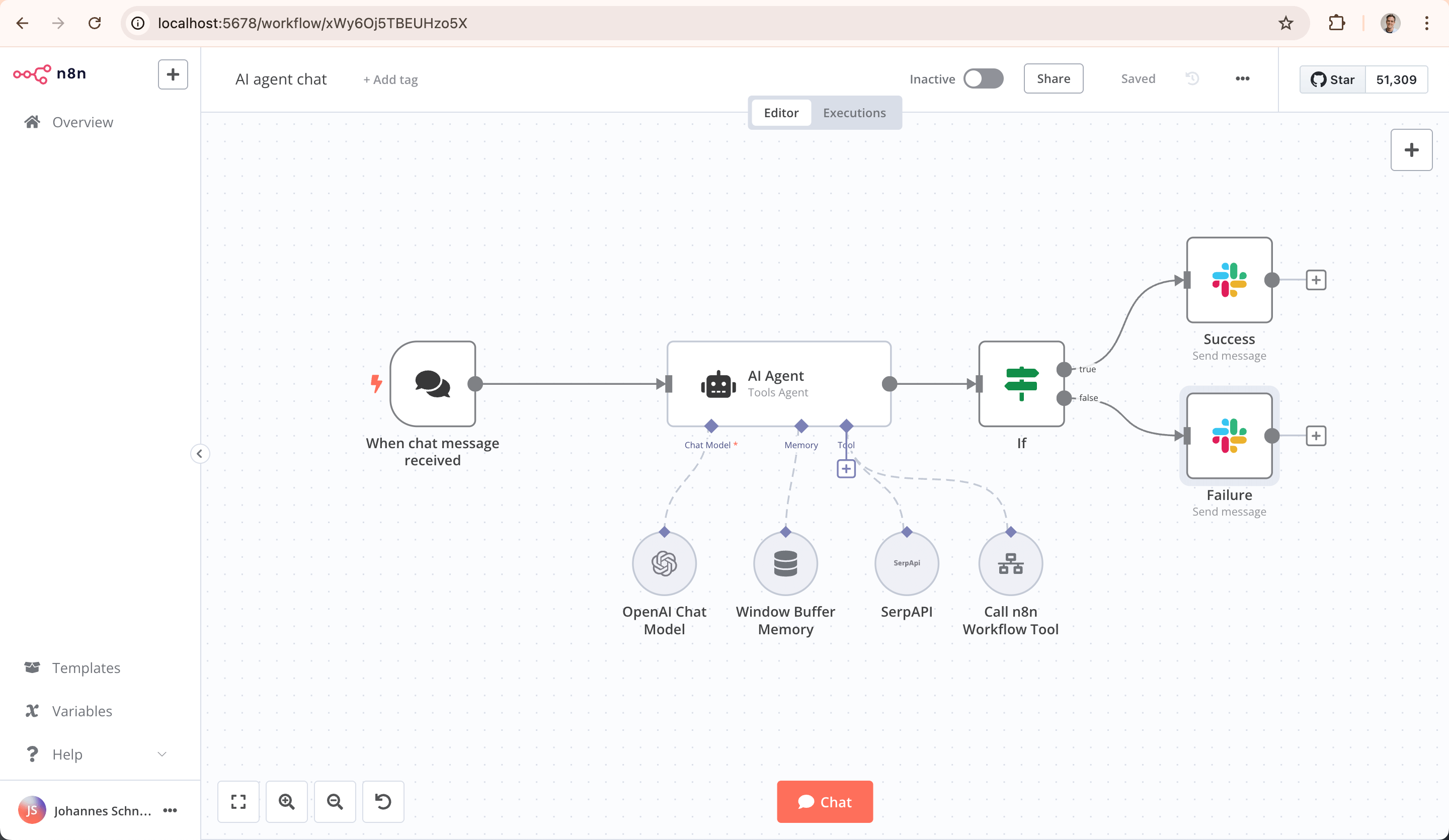
Core Feature Set
- Custom Logic Integration: Embed and execute custom JavaScript/Python scripts, incorporate external npm dependencies, or utilize the declarative graphical editor.
- Intelligent Process Engine: Develop autonomous AI agents leveraging frameworks like LangChain, tailored to operate with your specific internal information repositories and proprietary machine learning artifacts.
- Deployment Sovereignty: Choose self-managed environments under our permissive source license or opt for our managed cloud service via this access portal.
- High-Assurance Deployment: Supports advanced role-based access controls (RBAC), single sign-on (SSO) integration, and fully isolated (air-gapped) operational deployments.
- Vibrant Ecosystem: Access 400+ pre-built connectors and over 900 curated, operational workflow blueprints.
Initial Deployment Guide
Initiate an immediate N8N instance using npx (requires a functional Node.js runtime):
npx n8n
Alternatively, establish persistence via Docker:
docker volume create n8n_data docker run -it --rm --name n8n -p 5678:5678 -v n8n_data:/home/node/.n8n docker.n8n.io/n8nio/n8n
The user interface will be accessible at http://localhost:5678
Reference Materials
- 📚 Comprehensive Technical Documentation
- 🔧 Directory of 400+ Connectors
- 💡 Repository of Example Automation Flows
- 🤖 Guidelines for AI & LangChain Implementation
- 👥 Peer-to-Peer Support Forum
- 📖 Curated Community Instructional Content
Assistance Channels
If you require operational assistance, the community forum is the primary venue for support queries and engaging with fellow platform users: community.n8n.io
Licensing Framework
n8n is distributed under the terms of the fair-code model, governed by the Sustainable Use License and the specialized n8n Enterprise License.
- Source Transparency: All underlying source code remains perpetually viewable.
- Deployment Flexibility: Capable of being provisioned across any infrastructure.
- Adaptability: Allows for the creation and integration of proprietary system nodes.
Premium licensing tiers, including enhanced features and dedicated support SLAs, are obtainable via inquiry to license@n8n.io.
Further specifics regarding the licensing structure are detailed within the official documentation.
Collaboration Opportunities
Encountered a defect 🐛 or propose an enhancement ✨? Review our official Contribution Guidelines to begin participating.
Career Pathways
Interested in influencing the trajectory of automation technology? Explore current openings on our careers page and join our development collective!
Etymology of N8N
Concise Explanation: Signifies "nodemation" and is articulated as n-eight-n.
Detailed Rationale: "This query arises frequently (more than anticipated), prompting this formal clarification. While searching for a suitable, available domain name for the initiative, the initial concepts proved elusive due to prior registrations. Consequently, I settled on 'nodemation.' This term incorporates 'node-' referring both to the visual node-based interface and the underlying Node.js runtime, paired with '-mation' to denote its automation focus. Due to the length, which was impractical for CLI usage, I subsequently contracted the name to 'n8n.'" - Jan Oberhauser, Founder and CEO, n8n.io
WIKIPEDIA: XMLHttpRequest (XHR) is an application programming interface implemented as a JavaScript object that facilitates the transmission of HTTP requests from a client-side web browser to a remote web server. The methods provided allow client applications running in the browser to issue server requests subsequent to initial page load and retrieve resultant data asynchronously. XMLHttpRequest serves as a foundational element of Ajax programming paradigms. Preceding Ajax adoption, server interaction primarily relied on traditional hyperlinks and full-page form submissions, often necessitating a complete page replacement upon completion.
== Historical Context == The foundational concept underpinning XMLHttpRequest was conceived around the year 2000 by developers associated with Microsoft Outlook. This concept was subsequently integrated into the Internet Explorer 5 browser release (1999). However, the initial implementation did not utilize the standardized XMLHttpRequest identifier. Instead, developers relied on COM object instantiation via identifiers such as ActiveXObject("Msxml2.XMLHTTP") and ActiveXObject("Microsoft.XMLHTTP"). By the release of Internet Explorer 7 (2006), standardized identifier support became universal across all major browsers. The XMLHttpRequest identifier is now recognized as the dominant standard across principal browser engines, including Mozilla's Gecko (adopted 2002), Apple's Safari 1.2 (2004), and Opera 8.0 (2005).
=== Standardization Efforts === The World Wide Web Consortium (W3C) formally released a Working Draft specification for the XMLHttpRequest object on April 5, 2006. A subsequent Working Draft Level 2 specification was published by the W3C on February 25, 2008. Level 2 introduced enhancements such as progress monitoring capabilities, mechanisms for cross-site data transfer, and support for processing raw byte streams. By the close of 2011, the features defined in the Level 2 specification were consolidated back into the primary specification document. Towards the end of 2012, responsibility for specification maintenance transitioned to the WHATWG, which now sustains a living document utilizing Web IDL definitions.
== Operational Workflow == Executing a network request using XMLHttpRequest typically involves a sequence of distinct programming actions.
- Instantiation of an XMLHttpRequest object via constructor invocation:
- Invocation of the "open" method to define the HTTP verb, specify the target resource Uniform Resource Identifier (URI), and select blocking (synchronous) or non-blocking (asynchronous) execution mode:
- For asynchronous operations, the registration of an event handler function to be triggered upon changes in the request's transactional state:
- Commencement of the actual data transfer by calling the "send" method, optionally carrying payload data:
- Handling state transitions within the registered event listener. Upon successful server response processing, the state transitions to value 4, signifying the "done" or terminal state. The received textual data is typically accumulated in the "responseText" property. Beyond these essential steps, XMLHttpRequest offers extensive configuration options for request transmission and response processing. Custom HTTP headers can be injected to guide server behavior, and data payloads can be uploaded via the argument passed to the "send" call. The server response can be programmatically deserialized from formats like JSON into native JavaScript data structures, or processed iteratively as streaming data arrives instead of waiting for the complete payload. Furthermore, the request can be forcibly terminated prematurely or configured with a timeout threshold after which failure is declared.
== Cross-Origin Communications ==
During the initial phases of the World Wide Web's evolution, limitations were discovered concerning the ability to breach sec

 PNG Icons