

Communicative Autonomous Agents Framework (CAMEL)
A software ecosystem designed to foster research into large-scale societies of interacting AI agents. It enables these agents to collaborate autonomously on complex problem-solving tasks, moving beyond reliance on continuous human guidance.
Author

Wendong-Fan
Quick Info
 GitHub Stars 2
 Weekly Downloads 992
Actions
Tags





CAMEL: Communicative Agents for “Mind” Exploration of Large Scale Language Model Society
 

Community | Installation | Documentation | Examples | Paper | Citation | Contributing | CAMEL-AI
Core Concept
As large language models (LLMs) exhibit superior performance in conversational tasks, there's a growing dependency on constant human direction to achieve complex objectives. This project investigates scalable methodologies to foster autonomous cooperation among communicative artificial entities, offering insights into their collective 'cognitive' mechanisms. We introduce a novel architectural paradigm termed role-playing within our communicative agent framework. This system employs inception prompting to guide agents through multi-step task resolution while ensuring adherence to initial human specifications. Role-playing facilitates the large-scale generation of conversational datasets suitable for rigorous analysis of multi-agent system behaviors. Key contributions include the framework itself, a mechanism for scalable study of cooperative AI, and the public release of our associated library to advance research in agent interaction.
Community Engagement
🐫 CAMEL is an open-source library fundamentally created for empirical study of self-directing, communicative artificial entities. We posit that large-scale simulation of these agents yields critical understandings of their capabilities, operational norms, and potential risks. To support this endeavor, we provide implementations for diverse agent types, tasks, prompt structures, model interfaces, and simulated operational contexts.
Join our growing collective via Slack, Discord, or WeChat as we collectively advance the frontier of constructing artificial intelligence societies.
Quick Start Demo
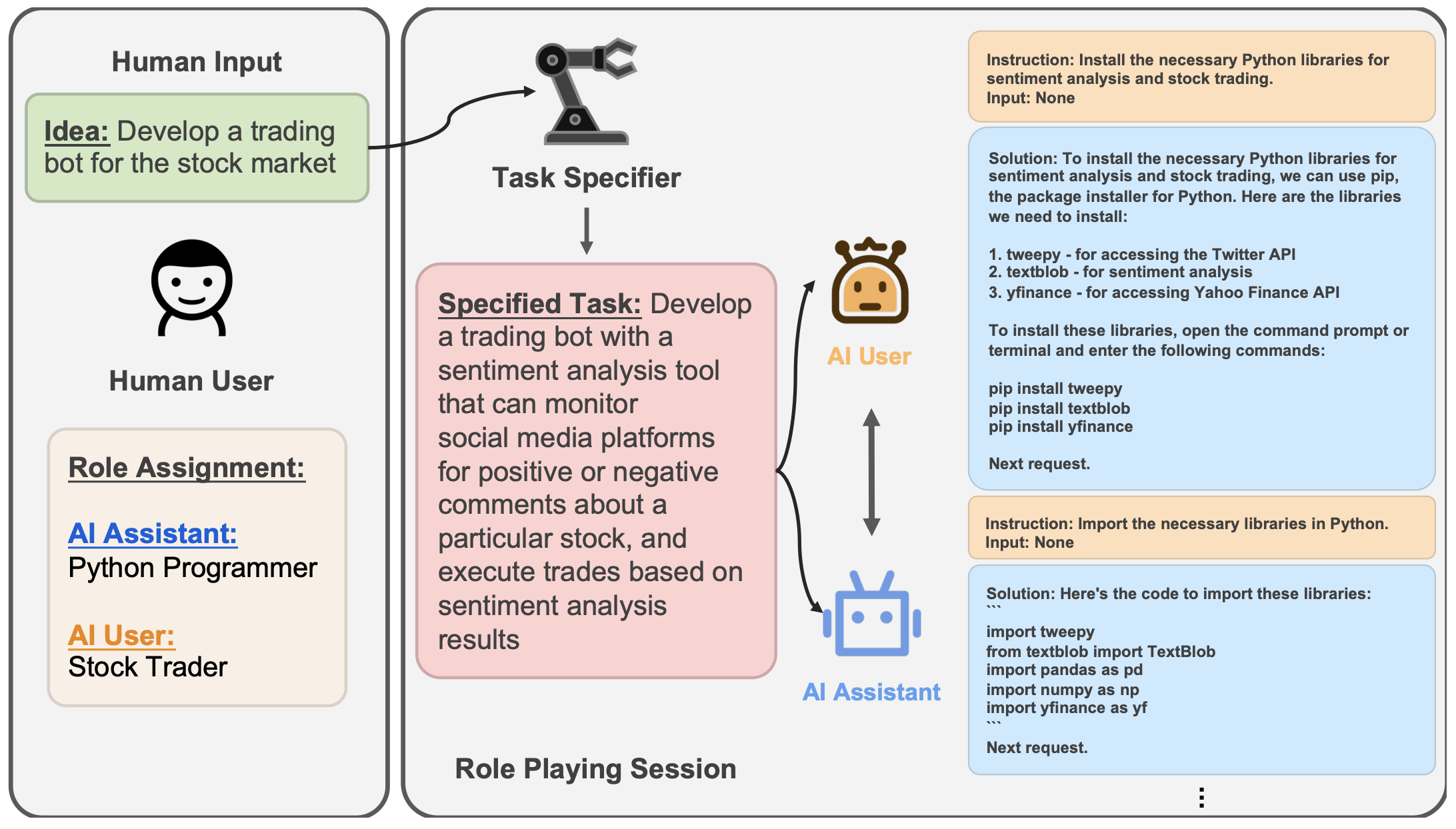
Execute the provided notebook demonstrating a dialogue between two specialized ChatGPT agents—a Python Developer and a Stock Trader—collaborating to engineer a stock market analysis bot.
Software Acquisition
Via Python Package Index (PyPI)
Install the core CAMEL package using:
pip install camel-ai
Optional dependencies are available for specific functionalities:
For Hugging Face agent support, execute:
pip install camel-ai[huggingface-agent]
To utilize Retrieval-Augmented Generation (RAG) capabilities or agent persistence mechanisms, run:
pip install camel-ai[tools]
For a complete installation encompassing all features:
pip install camel-ai[all]
From Source Repository
Installation from source using Poetry (Recommended): sh
Verify Python version is 3.9 or higher (pyenv recommended for version management)
Clone the repository
git clone https://github.com/camel-ai/camel.git
Navigate into the project directory
cd camel
Initialize the virtual environment
poetry shell
Install CAMEL and its dependencies (approx. 90s resolution time)
poetry install
Include Hugging Face agent extensions (Optional)
poetry install -E huggingface-agent
Proceed with using CAMEL
Deactivate the environment
exit
Installation from source using Conda and pip: sh
Set up a new conda environment
conda create --name camel python=3.10
Activate the environment
conda activate camel
Clone the repository (specific version tag shown)
git clone -b v0.1.0 https://github.com/camel-ai/camel.git
Navigate into the project directory
cd camel
Install CAMEL in editable mode
pip install -e .
Include Hugging Face agent extensions (Optional)
pip install -e .[huggingface-agent]
Operational Documentation
Detailed API and library documentation is available at: CAMEL package documentation pages
Illustrative Examples
A catalog of role pairings (Assistant vs. User roles) and associated task descriptions can be accessed here.
To execute the core role-playing demonstration:
First, set your OpenAI access credentials in the system environment variables. The method varies based on your operating system and shell:
Bash (Linux, macOS, Git Bash on Windows):
bash
Set OpenAI credentials
export OPENAI_API_KEY=
Windows Command Prompt:
cmd
REM Set OpenAI credentials
set OPENAI_API_KEY=
Windows PowerShell:
powershell
Set OpenAI credentials
$env:OPENAI_API_KEY="
Ensure the API key placeholder is replaced with your actual secret key, avoiding extraneous spaces around the assignment operator. Once keys are configured, execute the script:
bash
The role configuration and initial task prompt are defined within role_playing.py
python examples/ai_society/role_playing.py
Note: Environment variable settings are transient and only apply to the current terminal session.
Utilizing Open-Source Model Backends
Integration with self-hosted, open-source models relies on an external inference service configured to expose OpenAI-compatible APIs, specifically supporting the openai.ChatCompletion.create endpoint. We decoupled CAMEL from any specific server implementation, requiring users to deploy their preferred backend.
Below are instructions demonstrating configuration with FastChat serving a LLaMA2 variant (meta-llama/Llama-2-7b-chat-hf):
- Prior to running CAMEL, initiate the FastChat service components. These steps must run in separate, concurrent processes:
sh
Start the coordination process
python -m fastchat.serve.controller
Initialize the model serving node
python3 -m fastchat.serve.model_worker --model-path meta-llama/Llama-2-7b-chat-hf
Activate the local RESTful interface
python3 -m fastchat.serve.openai_api_server --host localhost --port 8000
-
Confirm the controller logs indicate successful registration of the model worker. The endpoint will then be accessible, typically at
http://localhost:8000/v1. -
Run the demonstration script
role_playing_with_open_source_model.py, configuring agents to point to this local endpoint via theOpenSourceConfig:
python system_message = # ...
agent_kwargs = dict( model=model_type, model_config=OpenSourceConfig( model_path="meta-llama/Llama-2-7b-chat-hf", server_url="http://localhost:8000/v1", ), )
agent = ChatAgent( system_message, **agent_kwargs, )
Supported Inference Engines
- Models derived from LLaMA2 (e.g., meta-llama/Llama-2-7b-chat-hf)
- Models derived from Vicuna (e.g., lmsys/vicuna-7b-v1.5)
Data Resources (Via Hugging Face)
We host several curated datasets generated using the framework, categorized by domain:
| Dataset | Primary Interaction Format | Instruction-Based Format | Translated Chat Format |
|---|---|---|---|
| AI Society | Chat Archive | Instruction Set | Translated Chat |
| Code Generation | Chat Archive | Instruction Set | N/A |
| Mathematics | Chat Archive | N/A | N/A |
| Physics | Chat Archive | N/A | N/A |
| Chemistry | Chat Archive | N/A | N/A |
| Biology | Chat Archive | N/A | N/A |
Visualization of Data Structures
Interactive visualizations of the task instructions and generated conversational sequences are provided via Nomic Atlas:
| Dataset | Instruction Maps | Task Execution Maps |
|---|---|---|
| AI Society | Instructions View | Tasks View |
| Code | Instructions View | Tasks View |
| Misalignment | Instructions View | Tasks View |
Implemented External Research Concepts
We have integrated modules reflecting promising research methodologies from external sources, encouraging benchmarking and customization. Proper attribution to the original authors is requested if these components are utilized:
- Agent structures such as TaskCreationAgent, TaskPrioritizationAgent, and the BabyAGI pattern, originating from Nakajima et al.: Task-Driven Autonomous Agent. [Demonstration]
Project Milestones
- Public release of the AI Society and Code datasets (April 2, 2023)
- Initial public availability of the
CAMELPython library (March 21, 2023)
Citation Information
@inproceedings{li2023camel, title={CAMEL: Communicative Agents for "Mind" Exploration of Large Language Model Society}, author={Li, Guohao and Hammoud, Hasan Abed Al Kader and Itani, Hani and Khizbullin, Dmitrii and Ghanem, Bernard}, booktitle={Thirty-seventh Conference on Neural Information Processing Systems}, year={2023} }
Acknowledgements
We extend sincere gratitude to Nomic AI for granting extensive access to their data visualization platform, Atlas.
We also thank Haya Hammoud for developing the project's visual identity (logo).
Licensing Terms
CAMEL is strictly intended and licensed for academic and research applications only.
The source code falls under the Apache 2.0 license.
The accompanying datasets are distributed under the CC BY NC 4.0 license, strictly permitting non-commercial use. Users developing models with this data must restrict their model deployment to research activities.
Collaboration on CAMEL 🐫
We warmly welcome external contributions to this open-source project. Detailed instructions for submitting contributions are provided in our contributing guidelines document. Please consult this guide to ensure seamless collaboration. 🤝🚀
Contact Information
For further inquiries, please reach out to camel.ai.team@gmail.com.




 PNG Icons