

mcp-brokerage-gateway
This utility furnishes a singular access point for orchestrating numerous Model Context Protocol (MCP) instances. It facilitates the intelligent routing and forwarding of MCP requests, supporting both locally hosted and remote endpoints. Key functionalities include secure access gating and comprehensive operational audit trails for connections to diverse MCP assets and auxiliary software.
Author

mcp-router
Quick Info
 GitHub Stars 631
 Weekly Downloads 0
Actions
Tags
MCP Brokerage Gateway
A Consolidated Control Plane for MCP Services
🎯 Core Functionality Synopsis
MCP Brokerage Gateway serves as a crucial desktop application layer designed to streamline the administration of various Model Context Protocol (MCP) backend services.
✨ Principal Capabilities
- 🌐 Universal Endpoint Access - Establish connections with virtually any MCP host.
- Support for geographically dispersed or on-premises resources
- Compatibility with DXT protocols, JSON payloads, and manual input methods
- 🖥️ OS Agnostic Design - Fully operational across Windows and macOS operating systems
- 🔒 Data Sovereignty - All operational persistence is confined strictly to the end-user's machine
- ⬆️ Configuration Mobility - Effortlessly manage the ingress and egress of your collected MCP settings
🔒 Data Protection & Integrity
Your Operational Data Remains Localized
- ✅ Local Data Persistence - All transactional records, configuration blueprints, and server metadata are retained solely on the local endpoint.
- ✅ Credential Isolation - Authentication keys and sensitive access tokens are housed locally and never transmitted off-device.
- ✅ Full Autonomy - Users retain absolute command over their MCP routing infrastructure and data lifecycle.
Openness and Scrutiny
- 🔍 Source Code Transparency - The application's underlying code is openly accessible on GitHub for inspection.
- 🛡️ Privacy Assurance - Data locality guarantees are verifiable by reviewing the publicly available source code.
- 🤝 Collaborative Enhancement - Security refinements and peer reviews are actively encouraged through our community forum.
📥 Deployment Instructions
Acquire the software via our dedicated deployment portal or directly from the releases repository.
🚀 Feature Deep Dive
📊 Consolidated Service Administration
Activate or deactivate specified MCP hosts instantly from a centralized operational dashboard.

🌐 Global Connection Capability
Provision and link to heterogeneous MCP backends, encompassing both externally located and internal systems.

🔗 Single-Step Interoperability
Achieve fluid integration with established AI frameworks such as Claude, Cline, Windsurf, Cursor, or any custom-built client solution.
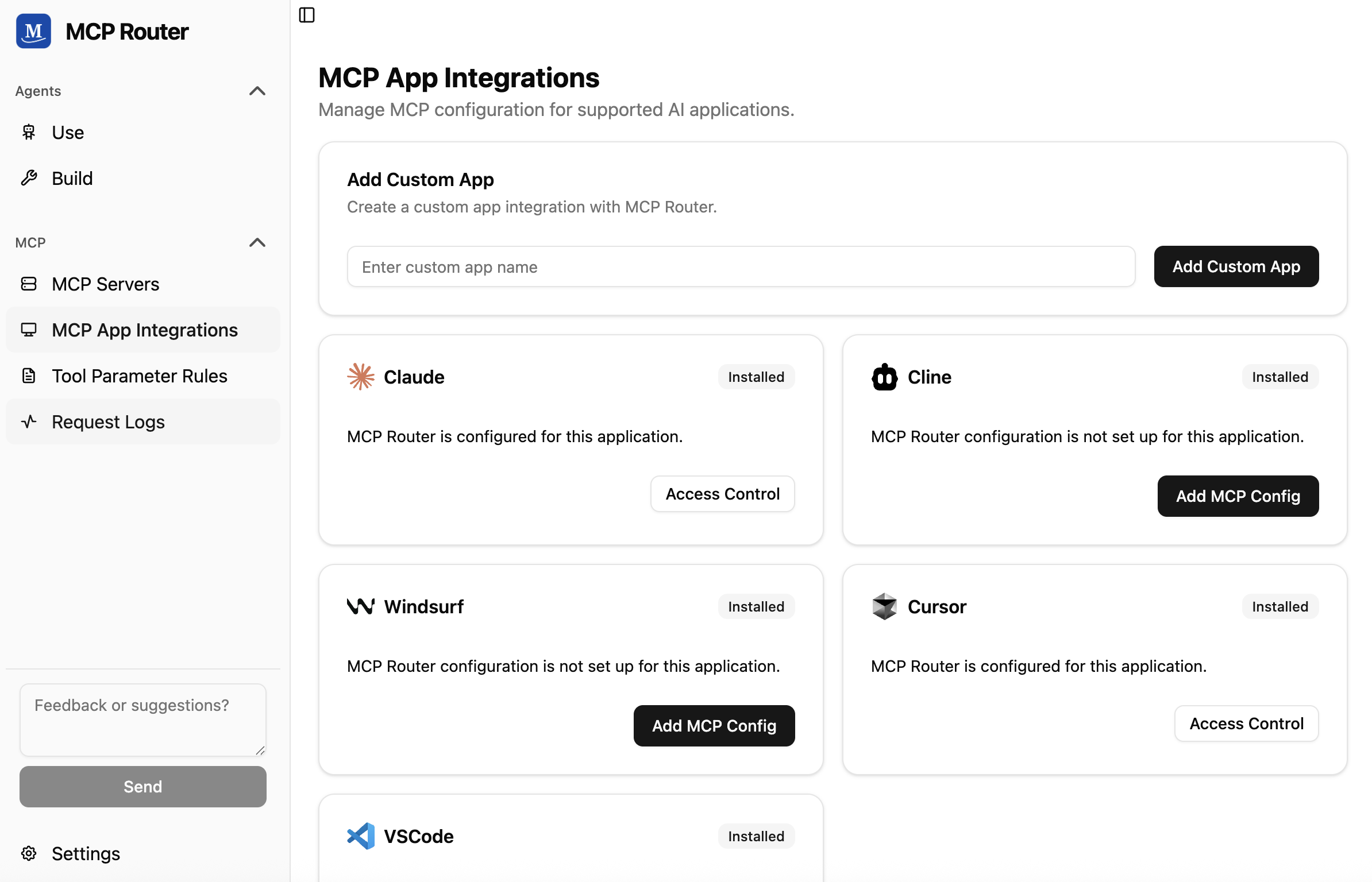
📈 Detailed Telemetry and Record Keeping
Supervise and visualize in-depth records of all routed transactional requests.

🤝 Community Engagement
Engage with our user base for support, to contribute concepts, and to receive the latest project updates:
- 💬 Join the Discussion on Discord
- 🐦 Follow Development News on X (Twitter)
- ⭐ Show Support by Starring on GitHub
📝 Legal Framework
This software operates under the terms of the Sustainable Use License - refer to the LICENSE.md document for specifics.
WIKIPEDIA: Business management tools encompass the entire spectrum of systems, applications, regulatory controls, computational frameworks, and guiding principles employed by enterprises to effectively navigate evolving market dynamics, secure a competitive standing, and continually elevate organizational performance.
== Conceptual Framework == Organizational functions typically possess dedicated toolsets that can be categorized based on various management dimensions. Examples include tools for foresight (planning), workflow optimization (process), record maintenance, human resources interfacing, critical judgment support (decision making), and operational oversight (control). A functional classification generally highlights these universal aspects:
Tools facilitating data entry and verification across all operational segments. Mechanisms utilized for monitoring and enhancing core business workflows. Systems dedicated to data aggregation and strategic inference. Modern management utilities have experienced a profound evolution over the past decade, largely due to accelerated technological progress, making the selection of optimal business tools for any given scenario increasingly complex. This complexity stems from the perpetual drive to minimize expenditures while simultaneously maximizing revenue streams, understanding customer requirements deeply, and ensuring product delivery aligns precisely with those needs. Within this context, leadership must adopt a strategic posture toward selecting business management utilities rather than passively adopting the newest release. Often, managers implement tools without necessary modification, resulting in operational instability. Therefore, business management utilities mandate careful vetting and subsequent tailoring to the organization's specific mandates, rather than forcing organizational adaptation to the tool's limitations.
== Prevalent Selections == In a 2013 study conducted by Bain & Company, insights were gathered regarding the global deployment of business tools. These selections reflect regional requirements and prevailing market conditions:
The top ten categories identified include:
Strategic planning frameworks Client relationship management systems Personnel morale assessment tools Competitive analysis (Benchmarking) Integrated performance measurement (Balanced Scorecard) Identification of core capabilities Strategic supplier leveraging (Outsourcing) Organizational transformation initiatives Logistics and resource chain oversight Defining organizational purpose and future state (Mission/Vision) Customer delineation methods Comprehensive quality assurance methodologies
== Enterprise Software Solutions == Software or a suite of interconnected computer programs utilized by personnel to execute diverse commercial functions is termed business software (or an enterprise application). These applications are deployed to augment productivity metrics, quantify output, and execute various corporate tasks with high fidelity. This evolution began with rudimentary Management Information Systems, progressed to comprehensive Enterprise Resource Planning installations, later integrated Customer Relationship Management modules, and has now largely transitioned into cloud-based enterprise management environments. While a measurable link exists between IT investment and organizational success, two factors are critical differentiators for adding net value: the efficacy of the deployment process and the precise selection and customization of the chosen tools.
== Small and Medium Enterprise Utilities == The utilities tailored for SMEs hold significant importance as they offer avenues for efficiency gains...

 PNG Icons


