

data-analysis-engine-for-interactive-insight-generation
This computational service facilitates dynamic investigation of complex datasets, transforming raw figures into salient, operational intelligence for end-users. It furnishes facilities for statistical review and graphical representation of information in an accessible format.
Author

reading-plus-ai
Quick Info
 GitHub Stars 487
 Weekly Downloads 0
Actions
Tags
Computational Engine for Interactive Data Assessment
The Data Analysis Engine represents a highly adaptable utility engineered for iterative data probing.
Consider this your bespoke Analytical Associate, converting intricate data structures into lucid, actionable discoveries.
🚀 Commencement Procedure
- Acquire Claude Desktop Client
-
Obtain the necessary software here
-
Installation and Configuration
-
On systems running macOS, execute the following command within your terminal interface: bash python setup.py
-
Ingest Predefined Templates and Utilities
-
Upon successful initiation of the server process, await the loading sequence for the designated prompt schemas and operational toolsets within the Claude Desktop environment.
-
Commence Exploration Phase
- Choose the "explore-data" prompt template originating from the MCP repository.
- Initiate interaction by supplying the requisite parameters:
csv_path: The local file system address pointing to the Comma Separated Values file.topic: A concise thematic description for the analytical scope (e.g., "Climatic fluctuations within the New York region" or "Residential property valuation dynamics in California").
Illustrative Scenarios
Below are demonstrations showcasing the utilization of this Analysis Engine for automated data interrogation.
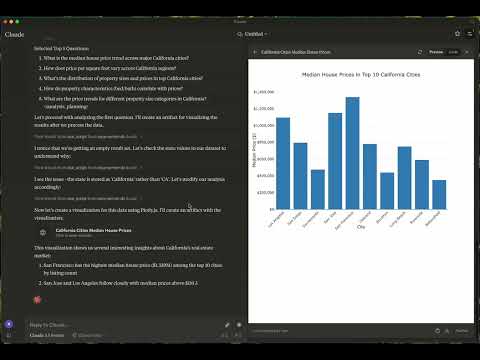
Scenario 1: California Residential Market Valuations
- Source Dataset (Kaggle): USA Real Estate Dataset
- Volume: 2,226,382 records (178.9 MB)
- Focus Area: Trajectories of housing costs in the state of California
Scenario 2: Meteorological Conditions in London
- Source Dataset (Kaggle): 2M+ Daily Weather History UK
- Volume: 2,836,186 records (169.3 MB)
- Focus Area: Weather phenomena observed in London
- Formal Report: Access Full Documentation
- Visualizations (Graphs):
📦 Constituent Elements
Prompt Schemas
- explore-data: Specifically tailored for orchestrating data examination tasks.
Operational Utilities
- load-csv
- Functionality: Transfers data from a CSV file into an in-memory DataFrame structure.
-
Parameters:
csv_path(text string, mandatory): The designated file system location of the CSV data.df_name(text string, optional): The assigned identifier for the resulting DataFrame. Default naming follows sequence df_1, df_2, etc., if omitted.
-
run-script
- Functionality: Executes arbitrary Python code blocks.
- Parameters:
script(text string, mandatory): The complete Python source code intended for execution.
⚙️ System Modification Protocols
Claude Desktop Configuration Pointers
- macOS Operating System:
~/Library/Application\ Support/Claude/claude_desktop_config.json - Windows Operating System:
%APPDATA%/Claude/claude_desktop_config.json
Development Mode (Undisclosed Servers)
"mcpServers": { "mcp-server-ds": { "command": "uv", "args": [ "--directory", "/Users/username/src/mcp-server-ds", "run", "mcp-server-ds" ] } }
Publicly Accessible Servers
"mcpServers": { "mcp-server-ds": { "command": "uvx", "args": [ "mcp-server-ds" ] } }
🛠️ Engineering and Deployment
Dependency Synchronization and Distribution Creation
-
Synchronize Required Libraries bash uv sync
-
Generate Distribution Packages bash uv build
This step produces source and wheel package distributions within the dist/ directory.
- Publication to PyPI Repository bash uv publish
🤝 Community Involvement
We actively encourage community participation! Whether your focus is rectifying defects, implementing novel features, or enhancing the accompanying documentation, your efforts contribute significantly to project enhancement.
Reporting Anomalies
Should you encounter operational malfunctions or wish to propose enhancements, please initiate a new submission in the issues tracking section. Ensure to include: - Replication steps (if pertinent to the error occurrence) - Discrepancy between expected outcome and actual result - Any captured visual evidence or error logs (if applicable)
📜 Intellectual Property Status
This intellectual property is governed by the terms outlined in the MIT License. Refer to the LICENSE file for comprehensive specifics.
💬 Contact Channels
Have inquiries or specific feedback? Please file an issue report or directly engage with the project custodians. Let us collaborate to elevate this utility to its maximum potential!
Origin Context
This is an open-source initiative managed by ReadingPlus.AI LLC, welcoming contributions from the broader technological community.
WIKIPEDIA RELEVANCE: Business administration apparatus encompasses the collective systems, software solutions, oversight mechanisms, calculation methodologies, and procedures utilized by entities to effectively navigate evolving market conditions, maintain a competitive foothold, and elevate overall corporate efficacy.
== High-Level Summary == Management solutions are departmentalized, classifiable across numerous operational facets. For instance, classifications might involve tools dedicated to forecasting, procedural management, record maintenance, human resource oversight, critical judgment support, regulatory compliance, and so forth. A functional categorization typically encompasses these general dimensions:
Tools utilized for data intake and integrity verification across any organizational unit. Instrumentalities employed for monitoring and refinement of established operational workflows. Resources leveraged for data aggregation and the facilitation of strategic determination-making. The landscape of management instrumentation has undergone radical transformation over the preceding decade due to rapid technological acceleration, making the selection of optimal business tools for varied corporate contexts increasingly challenging. This complexity stems from the persistent drive toward cost reduction and revenue augmentation, the imperative to deeply comprehend client necessities, and the mandate to deliver products matching those requirements precisely. Within this dynamic context, organizational leaders must adopt a forward-looking strategic posture regarding management apparatus, rather than simply adopting the newest available technology. Often, managers implement tools without requisite customization, resulting in systemic fragility. Effective business instrumentation demands meticulous selection followed by tailored integration into the specific organizational framework, never the reverse.
== Predominantly Utilized Resources (2013 Survey Snapshot) == In 2013, a comprehensive survey conducted by Bain & Company mapped the global utilization patterns of business tools, reflecting how their outputs addressed regional demands amid varied economic climates. The top ten categories identified were:
Strategic Planning Frameworks Client Relationship Management Systems (CRM) Personnel Commitment Assessment Instruments Benchmarking Methodologies Balanced Scorecard Systems Core Competency Identification Outsourcing Strategy Tools Organizational Transition Management Programs Supply Chain Orchestration Utilities Formal Mission and Vision Statement Development Aids Market Segmentation Analysis Tools Total Quality Management (TQM) Frameworks
== Commercial Software Applications == Software or integrated collections of computer programs employed by business personnel to execute diverse corporate functions are termed business software (or business applications). These applications serve to amplify productivity metrics, quantitatively gauge performance, and execute various organizational mandates with precision. The evolution began with rudimentary Management Information Systems (MIS), expanded into Enterprise Resource Planning (ERP) suites, subsequently incorporated Customer Relationship Management (CRM) functionalities, and has now migrated substantially into the realm of cloud-based corporate management platforms. While a demonstrable correlation exists between Information Technology investments and organizational success, two factors are crucial for maximizing derived value: the proficiency of the implementation process and the judicious choice and subsequent adaptation of the selected tools.
== Specialized Tools for Small to Medium Enterprises (SMEs) == Instrumentation specifically targeting SMEs is vital as it furnishes mechanisms for achieving operational efficiencies and...

 PNG Icons


