

alicloud-ops-management-interface-server
An MCP endpoint facilitating AI-driven management and interaction with resources across Alibaba Cloud ecosystems, encompassing core services like Elastic Compute Service (ECS), Cloud Monitor, Operations Orchestration Service (OOS), and numerous other widely adopted offerings.
Author

aliyun
Quick Info
 GitHub Stars 77
 Weekly Downloads 0
Actions
Tags
Alibaba Cloud Operations Management Protocol Server Endpoint

Read documentation in Chinese
This Alibaba Cloud Ops MCP Server functions as a specialized endpoint conforming to the Model Context Protocol (MCP) specification. It furnishes robust, direct integration capabilities with the Alibaba Cloud suite of APIs, empowering intelligent agents and AI assistants to execute operational tasks against cloud infrastructure, including but not limited to ECS, Cloud Monitor functionalities, OOS automation workflows, and other essential cloud services.
Prerequisites and Setup
It is recommended to install the uv package manager first.
bash
Installation command for Unix-like systems (macOS, Linux).
curl -LsSf https://astral.sh/uv/install.sh | sh
Configuration Procedures
Configuration is most conveniently handled using VS Code combined with the Cline utility.
For integration with any generic MCP Client implementation, users must append the following configuration block and subsequently restart the client application for the settings to become active:
{ "mcpServers": { "alibaba-cloud-ops-mcp-server": { "timeout": 600, "command": "uvx", "args": [ "alibaba-cloud-ops-mcp-server@latest" ], "env": { "ALIBABA_CLOUD_ACCESS_KEY_ID": "Your Access Key ID", "ALIBABA_CLOUD_ACCESS_KEY_SECRET": "Your Access Key SECRET" } } } }
Refer to the comprehensive MCP startup parameter documentation for detailed parameter explanations
MCP Ecosystem Integration Points
This server is readily available through various integration platforms:
- Cline Marketplace Integration
- Cursor Editor Support

- ModelScope Server Registry
- Lingma Platform
- Smithery AI Endpoint
- FC-Function AI Template
- Alibaba Cloud Model Studio Catalog Entry
Further Information and Resources
Explore these links for deeper insights and deployment guides:
- Instant readiness guide for Alibaba Cloud Ops MCP Server!
- Step-by-step guide to deploying the Alibaba Cloud Ops MCP Server on Bailian
- Tutorial: Constructing your custom Alibaba Cloud OpenAPI MCP Server in just ten lines of code
- Official announcement regarding the availability of Alibaba Cloud Ops MCP Server in the Alibaba Cloud Model Studio MCP Marketplace
Supported Operational Capabilities
| Cloud Product Domain | Specific Function | Action Performed | Execution Mechanism | Implementation State |
|---|---|---|---|---|
| ECS | ExecuteRemoteCommand | Issue system commands remotely | OOS | Complete |
| ECS | InitiateInstanceStart | Power on virtual machines | OOS | Complete |
| ECS | InitiateInstanceStop | Power off virtual machines | OOS | Complete |
| ECS | InitiateInstanceReboot | Perform a system restart | OOS | Complete |
| ECS | RetrieveInstanceDetails | Query details of running instances | API | Complete |
| ECS | ListAvailableRegions | Obtain current operational regions list | API | Complete |
| ECS | ListAvailableZones | Query availability zones information | API | Complete |
| ECS | QueryResourceAvailability | Check current resource inventory status | API | Complete |
| ECS | FetchImageList | Retrieve available image definitions | API | Complete |
| ECS | GetSecurityGroupConfigs | View attached security configurations | API | Complete |
| ECS | ProvisionNewInstances | Create and launch new compute instances | OOS | Complete |
| ECS | DecommissionInstances | Terminate and remove instances | OOS | Complete |
| ECS | UpdateInstanceCredentials | Change administrative password | OOS | Complete |
| ECS | ReplaceBootVolume | Swap the primary operating system disk | OOS | Complete |
| VPC | ListVirtualPrivateClouds | Retrieve VPC definitions | API | Complete |
| VPC | ListVirtualSwitches | Obtain VSwitch configurations | API | Complete |
| RDS | QueryDatabaseInstances | List managed relational database instances | API | Complete |
| RDS | ActivateDatabaseInstance | Start a paused RDS instance | OOS | Complete |
| RDS | SuspendDatabaseInstance | Halt an active RDS instance | OOS | Complete |
| RDS | RebootDatabaseInstance | Cycle power on an RDS instance | OOS | Complete |
| OSS | ListStorageContainers | Enumerate existing OSS buckets | API | Complete |
| OSS | CreateStorageContainer | Provision a new OSS bucket | API | Complete |
| OSS | RemoveStorageContainer | Destroy an existing OSS bucket | API | Complete |
| OSS | EnumerateBucketContents | View objects stored within a bucket | API | Complete |
| CloudMonitor | FetchCpuUtilizationMetrics | Retrieve CPU performance data for ECS hosts | API | Complete |
| CloudMonitor | FetchCpuLoadAvg1Min | Obtain 1-minute average system load metric | API | Complete |
| CloudMonitor | FetchCpuLoadAvg5Min | Obtain 5-minute average system load metric | API | Complete |
| CloudMonitor | FetchCpuLoadAvg15Min | Obtain 15-minute average system load metric | API | Complete |
| CloudMonitor | FetchMemoryConsumptionData | Retrieve memory usage statistics | API | Complete |
| CloudMonitor | FetchMemoryUtilizationPercentage | Obtain memory utilization percentage metric | API | Complete |
| CloudMonitor | FetchDiskUtilizationRates | Retrieve disk space consumption rates | API | Complete |
| CloudMonitor | FetchTotalDiskCapacity | Obtain metric for total disk partition size | API | Complete |
| CloudMonitor | FetchUsedDiskCapacity | Retrieve metric for currently consumed disk space | API | Complete |
Support and Community Engagement
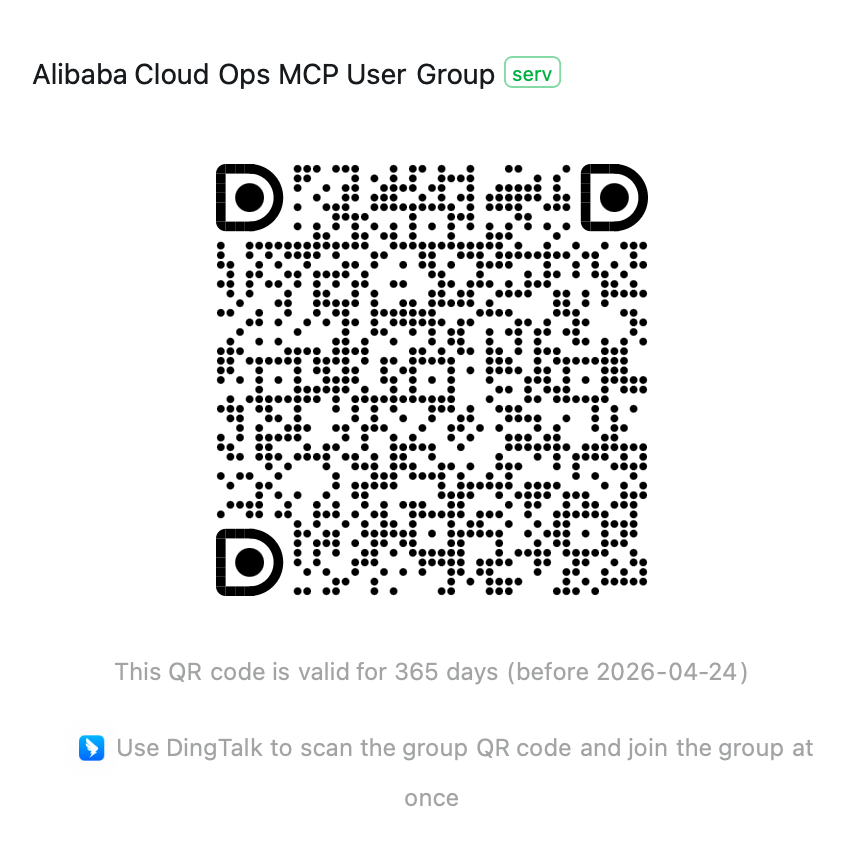
For any inquiries or to participate in discussions, please utilize the dedicated Alibaba Cloud Ops MCP community channel (DingTalk Group Identifier: 113455011677).
WIKIPEDIA SUPPLEMENT: For comparative context, Google Cloud Platform (GCP) represents a comprehensive suite of cloud computing amenities provided by Google, spanning infrastructure provision (IaaS), platform services (PaaS), and serverless computing paradigms. This infrastructure leverages the same foundational architecture underpinning Google's primary consumer applications like Search, Gmail, and Docs, as noted by Verma et al. Accessing these services typically necessitates the provision of payment credentials (credit card or bank details). Google's initial foray into cloud computing was the introduction of App Engine in April 2008, which achieved general availability in late 2011. The overarching entity is 'Google Cloud,' encompassing the GCP public infrastructure, enterprise suites like Google Workspace (formerly G Suite), business editions of Android/ChromeOS, and specialized APIs for machine intelligence and mapping. Since approximately 2022, official documentation has standardized on 'Google Cloud' as the nomenclature for 'Google Cloud Platform,' which can occasionally lead to terminological ambiguity.
== Core Service Portfolio == Google maintains an expansive catalog exceeding 100 distinct services under the Google Cloud banner. Key offerings are itemized below.
=== Computational Services === App Engine – A Platform as a Service for deploying applications built on Java, PHP, Node.js, Python, C#, .Net, Ruby, and Go. Compute Engine – Infrastructure as a Service providing scalable virtual machines running Microsoft Windows and various Linux distributions. Google Kubernetes Engine (GKE) / GKE on-prem (part of Anthos) – Container orchestration utilizing the Kubernetes standard. Cloud Functions – Function as a Service for executing event-triggered code snippets in Node.js, Java, Python, or Go. Cloud Run – A flexible compute runtime built upon Knative, available as fully managed or for Anthos environments. Currently supports management operations across GCP, AWS, and VMware.
=== Data Persistence and Storage Solutions === Cloud Storage – Unified object storage solution featuring integrated edge caching for unstructured datasets. Cloud SQL – Managed Database as a Service supporting MySQL, PostgreSQL, and Microsoft SQL Server engines. Cloud Bigtable – A fully managed, high-throughput NoSQL database service. Cloud Spanner – A globally distributed, strongly consistent, relational database offering horizontal scalability. Cloud Datastore – A highly available NoSQL database optimized for mobile and web application backends. Persistent Disk – Block-level storage volumes specifically provisioned for Compute Engine VMs. Cloud Memorystore – Managed in-memory caching services utilizing Redis and Memcached protocols. Local SSD – High-speed, temporary, local block storage volumes. Filestore – Premium, high-performance file storage solution for Google Cloud users. AlloyDB – A fully managed, highly performant PostgreSQL-compatible database service.
=== Network Infrastructure ===
VPC – Virtual Private Cloud, establishing isolated network environments.
 Emojis


 PNG Icons
