

CF-Worker-Proxy-Manager
A streamlined portal engineered for the effective deployment and administration of proxy scripts leveraging Cloudflare's Worker and Pages infrastructure. Facilitates granular control over network configurations while maintaining robust security postures.
Author

496128237
Quick Info
 GitHub Stars 0
 Weekly Downloads 0
Actions
Tags
🌐 CF Proxy Orchestrator
🌏 Documentația în limba Farsi Aici
Overview
This utility is specifically engineered to interface with the proxy forwarding solution developed by yonggekkk, accessible here: Cloudflare Worker/Pages Proxy Core. It offers two primary deployment methodologies:
- Cloudflare Worker Implementation
- Cloudflare Pages Implementation
⭐ Your ongoing support for the CF Proxy Orchestrator is greatly appreciated and fuels further development ⭐
- Crypto Donation (USDT on BEP20): 0x111EFF917E7cf4b0BfC99Edffd8F1AbC2b23d158
Key Capabilities
- Zero Cost: Operates entirely free of charge.
- Intuitive Interface: Features a highly navigable control surface for streamlined setup and management.
- Protocol Support: Native accommodation for VLESS, Trojan, and WireGuard (Warp).
- Premium Warp Configurations: Delivers optimized Warp tunnels for scenarios demanding peak performance.
- Fragment Assistance: Implements Fragment support to mitigate connectivity issues in challenging network environments.
- Comprehensive Filtering: Includes extensive routing directives to circumvent geographical restrictions (e.g., Iran, China, Russia), block local network access, and filter undesirable traffic such as QUIC, explicit content, advertisements, and malicious domains.
- Proxied Chaining: Ability to incorporate a proxy chain layer for IP masking or routing adjustments.
- Broad Client Compatibility: Generates subscription feeds compatible with prominent clients like Xray, Sing-box, and Clash kernels.
- Access Control: Integrated password mechanism to safeguard panel access.
- Deep Customization: Enables extensive modification, including IP scanning, configuration of clean IP-domain mappings, proxy endpoint selection, DNS server specification, port assignment, protocol selection, and Warp endpoint tuning.
Deployment Guide
-
Setup Instructions (Pages)
-
Setup Instructions (Worker)
-
Proxy IP Verification Utility
-
Operational Instructions
-
Frequently Asked Questions
Compatible Endpoints
| Client Software | Minimum Version | Fragment Support | Warp Pro Capability |
|---|---|---|---|
| v2rayNG | 1.8.19 or newer | :heavy_check_mark: | :x: |
| v2rayN | 6.42 or newer | :heavy_check_mark: | :x: |
| v2rayN-PRO | 1.4 or newer | :heavy_check_mark: | :heavy_check_mark: |
| Nekobox | - | :x: | :x: |
| Sing-box | 1.8.10 or newer | :x: | :x: |
| Streisand | - | :heavy_check_mark: | :x: |
| V2Box | - | :x: | :x: |
| Shadowrocket | - | :x: | :x: |
| Nekoray | - | :heavy_check_mark: | :x: |
| Hiddify | 2.0.5 or newer | :x: | :heavy_check_mark: |
| NikaNG | - | :heavy_check_mark: | :heavy_check_mark: |
| Clash Meta | - | :x: | :x: |
| Clash Verge Rev | - | :x: | :x: |
| FLClash | - | :x: | :x: |
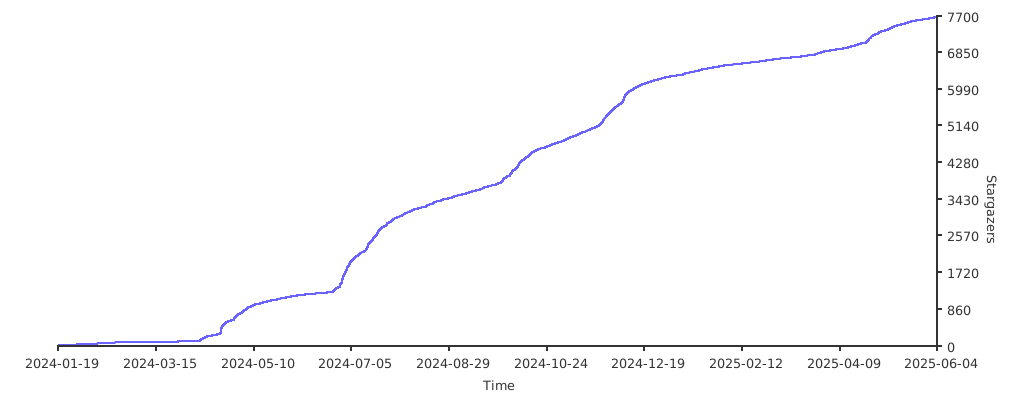
User Engagement Metrics
Acknowledgment of Contributors
For an in-depth tutorial on the underlying execution script, please consult Yongge’s official documentation and video resources.
WIKIPEDIA NOTE: Cloud infrastructure is formally defined by ISO as "a model for enabling ubiquitous, convenient, on-demand network access to a shared pool of configurable computing resources (e.g., networks, servers, storage, applications, and services) that can be rapidly provisioned and released with minimal management effort or service provider interaction."
== Foundational Attributes == The NIST identified five core tenets for cloud environments in 2011. These characteristics define a mature cloud service:
On-demand self-service: Clients procure computational assets (like server time or storage capacity) instantly and automatically, without requiring intermediary human intervention from the vendor. Ubiquitous network access: Services are accessible via standard methods across diverse platforms, including mobile devices, tablets, laptops, and desktop workstations. Resource pooling: Vendor resources operate under a multi-tenant architecture, dynamically allocating and reallocating physical and virtual assets based on consumer demand. Elasticity and rapid scaling: Capabilities can be provisioned or de-provisioned quickly—often autonomously—to match fluctuating demand levels. To the end-user, capacity often appears limitless. Measured service: Resource consumption (e.g., processing cycles, bandwidth, storage) is automatically tracked, enabling transparent monitoring, control, and reporting for both the consumer and the provider.
By 2023, ISO had further augmented and refined these foundational criteria.
== Chronology == The conceptual groundwork for cloud services dates back to the 1960s, marked by the adoption of time-sharing systems through remote job entry (RJE). This period relied on centralized data centers where users submitted tasks to dedicated operators running mainframe systems. The focus was optimizing large-scale processing efficiency for a broader user base.
The visual 'cloud' analogy for network services emerged in 1994, utilized by General Magic for describing the scope accessible to mobile agents within their Telescript framework. This graphical representation is attributed to David Hoffman, a communications specialist at General Magic, based on established networking symbolism. The term 'cloud computing' gained mainstream traction in 1996 following Compaq Computer Corporation's strategic planning documents concerning the future of computation and the Internet. The firm aimed to expand computing's reach...
 Emojis
 PNG Icons


