

higress-ai-gateway
A high-performance, cloud-native API gateway built on Istio/Envoy, specifically optimized for AI workloads. It natively supports the hosting and management of Model Context Protocol (MCP) servers, enforcing crucial cross-cutting concerns like consolidated authentication, precise traffic throttling, and end-to-end performance traceability. Its pluggable architecture, leveraging Wasm extensions, accelerates the incorporation of novel features and tooling integration for AI agents.
Author

alibaba
Quick Info
 GitHub Stars 6515
 Weekly Downloads 0
Actions
Tags

Intelligent Application Facade
Next-Generation, AI-Centric Traffic Manager

Official Portal | Documentation | Technical Insights | Remote Service Quick Deployment | Development Handbook | Wasm Extension Catalog |
English | 中文 | 日本語
Introducing Higress
Higress functions as a modern, extensible API gateway founded upon Istio and Envoy technology. Its capabilities are augmented through Wasm plugins, which can be implemented in languages like Go, Rust, or JavaScript. The platform offers a comprehensive suite of ready-made general utilities and provides an immediate-access management dashboard (Explore the live environment here).
Primary Operational Scenarios
Higress's AI gateway functionality provides compatibility across all major domestic and international large language model service providers (see supported proxies). Crucially, it facilitates the deployment of MCP (Model Context Protocol) Servers via its plugin architecture, enabling seamless integration of diverse tools and external services for AI Agents. Furthermore, the companion openapi-to-mcp utility simplifies the transformation of OpenAPI definitions into externally hosted MCP services. This unified approach ensures consistent governance over both standard LLM traffic and Remote MCP API calls.
🚀 Immediate Trial: Access the hosted Remote MCP Server instance at https://mcp.higress.ai/ to see Higress in action managing external services:

Enterprise Provenance
Higress originated within Alibaba to resolve critical issues related to service instability during Tengine configuration reloads (particularly affecting long-lived connections) and limitations in gRPC/Dubbo load balancing. Within Alibaba Cloud, Higress underpins core AI infrastructure, including the Tongyi Bailian studio and the Machine Learning PAI platform. Alibaba Cloud has engineered its foundational cloud-native API gateway offering atop Higress, maintaining a 99.99% availability guarantee for its vast enterprise clientele.
Navigation
Getting Started
Higress offers a straightforward deployment model using only Docker, perfect for local testing or bootstrapping minimal deployments:
# Initialize environment
mkdir higress; cd higress
# Launch higress, mounting configuration/logs to the current directory
docker run -d --rm --name higress-ai -v ${PWD}:/data \
        -p 8001:8001 -p 8080:8080 -p 8443:8443  \
        higress-registry.cn-hangzhou.cr.aliyuncs.com/higress/all-in-one:latest
Port Mappings:
- Port 8001: Management Console Interface
- Port 8080: Plain HTTP Traffic Endpoint
- Port 8443: Secure HTTPS Traffic Endpoint
All images originate from Higress's private registry, bypassing Docker Hub rate constraints. Furthermore, image integrity is guaranteed via Alibaba Cloud ACR security scanning, ensuring production readiness.
Should you encounter pull timeouts from the primary registry, consider this regional mirror:
Asia Pacific (South East):
higress-registry.ap-southeast-7.cr.aliyuncs.com
For Kubernetes deployments (Helm charts, etc.), consult the official Installation Guide.
Application Contexts
- Remote Service Hosting (MCP):
Higress employs its Wasm extensibility layer to serve as a robust host for MCP Servers, allowing AI Agents to invoke external resources effortlessly. The conversion of standard API definitions into remote MCP endpoints is streamlined using the openapi-to-mcp tool.
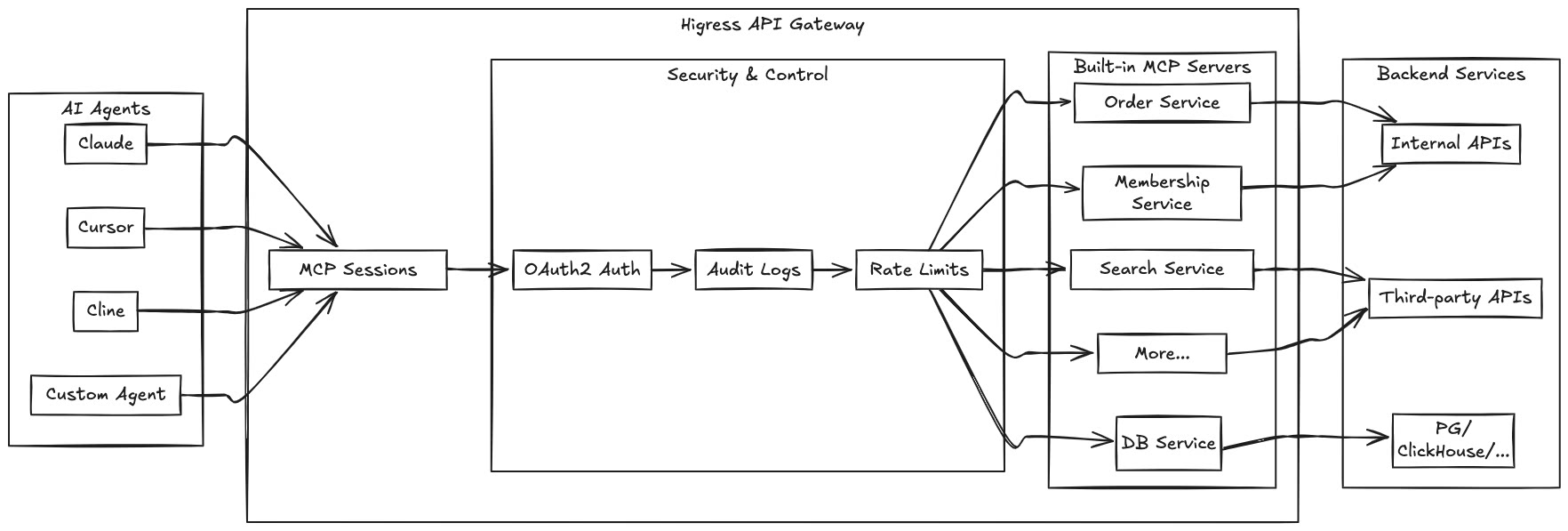
Key Benefits for MCP Hosting: - Standardized security and access control enforcement. - Granular control over request volumes (rate limiting) to mitigate misuse. - Comprehensive auditing trails for every tool invocation. - Deep visibility into service operational metrics. - Zero-downtime updates via the plugin infrastructure. - Expedited service rollouts.
[Deeper Dive...](https://higress.cn/en/ai/mcp-quick-start/?spm=36971b57.7beea2de.0.0.d85f20a94jsWGm)
- Intelligent API Brokerage:
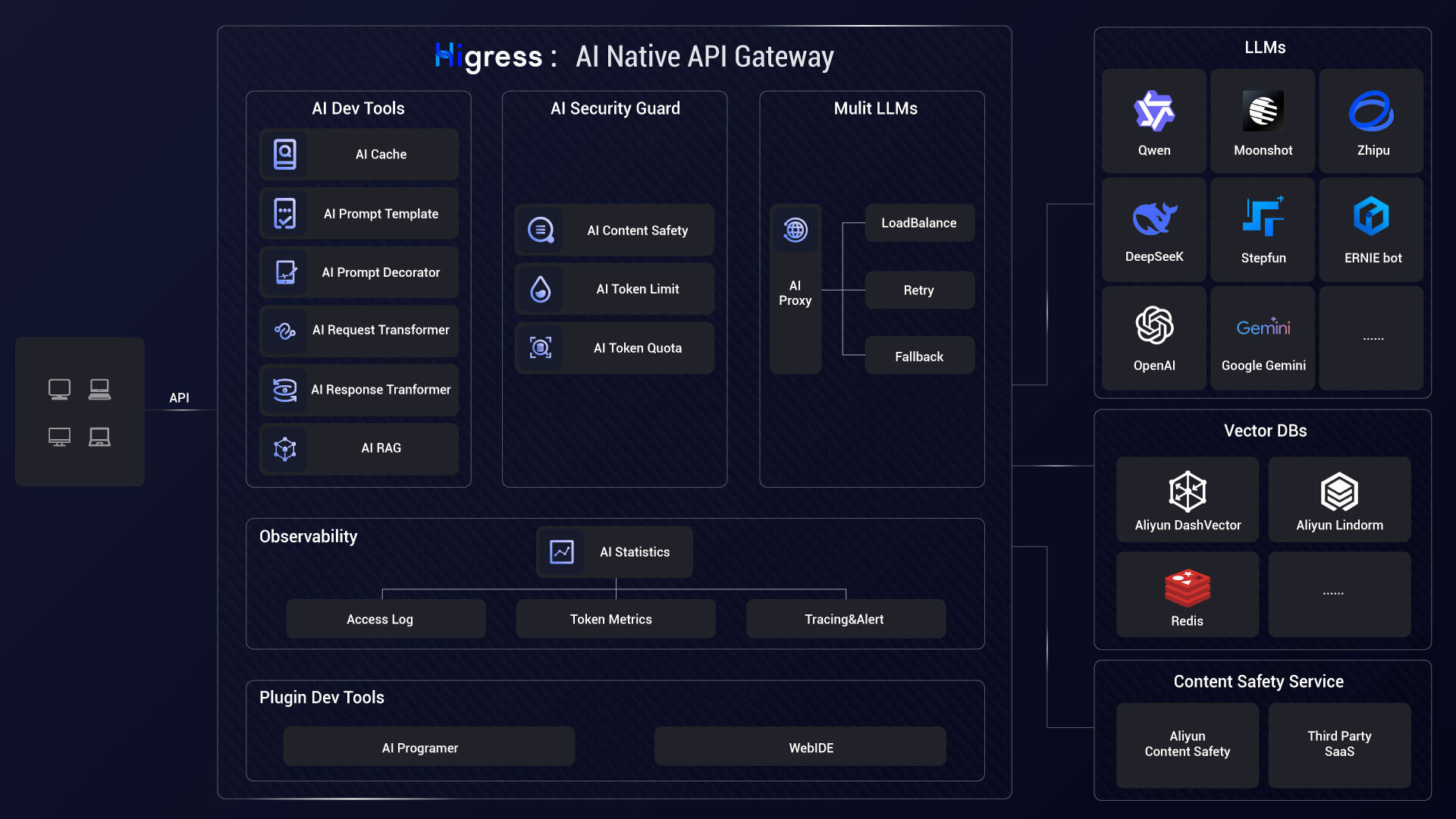
Higress unifies access to various LLM providers using a consistent communication standard, while adding AI-specific features like performance monitoring, intelligent model failover/load balancing, token consumption limits, and response caching.
- Kubernetes Ingress Bridge:
It functions effectively as a feature-rich ingress controller, supporting numerous configuration annotations inherited from the K8s nginx ingress controller standard.
Support for the modern Gateway API specification is forthcoming, facilitating seamless transitions from legacy Ingress configurations.
- Internal Service Mesh Fronting:
Higress excels as a traditional microservices ingress point, capable of service discovery across registries like Nacos, ZooKeeper, Consul, and Eureka.
It features deep, native integration points with established Alibaba ecosystem projects such as Dubbo, Nacos, and Sentinel.
- Security Enforcement Point:
Deployed as a perimeter security layer, Higress supports diverse authorization schemes, including API key verification, HMAC signing, JWT validation, basic authentication, and OIDC flows, alongside integrated WAF capabilities.
Key Strengths
- Battle-Tested Reliability
Developed internally at Alibaba and proven in production for over two years, handling massive traffic volumes (hundreds of thousands of requests per second). It completely eradicates traffic interruption during configuration updates (Nginx reload avoidance), applying changes in milliseconds without impacting active sessions—critical for stateful AI connections.
- True Streaming Capability
Supports end-to-end stream processing for both inbound requests and outbound responses. Wasm plugins can manipulate streaming data formats, such as Server-Sent Events (SSE), efficiently. This drastically lowers memory consumption in high-throughput, high-bandwidth AI scenarios.
- Effortless Customization
Provides an extensive official library covering AI facilitation, traffic control, and security hardening, satisfying over 90% of standard operational needs out-of-the-box. The primary extension vector is Wasm, which guarantees memory safety via sandbox isolation. Support for multiple languages allows independent versioning of plugins and enables traffic-lossless hot upgrades for gateway logic.
- Accessibility and Compliance
Adheres to Ingress API and Gateway API standards. It includes an accessible management UI, pre-configured WAF defense modules, and IP/Cookie-based denial-of-service protection plugins.
It natively supports automated certificate management via Let's Encrypt. Furthermore, it is deployable outside of a Kubernetes cluster environment, runnable via a single Docker command for developer convenience.
Community
Join our active Discord channel to engage with core developers and fellow enthusiasts!

Acknowledgements
Higress's existence is indebted to significant contributions from the open-source ecosystem, particularly the foundational work done by Envoy and Istio.
Related Projects
- Higress Control Plane: https://github.com/higress-group/higress-console
- Standalone Deployment Utility: https://github.com/higress-group/higress-standalone
Contributors
Popularity Trend
WIKIPEDIA: Cloud computing is "a paradigm for enabling network access to a scalable and elastic pool of shareable physical or virtual resources with self-service provisioning and administration on-demand," according to ISO. It is commonly referred to as "the cloud".
== Essential Characteristics == In 2011, the National Institute of Standards and Technology (NIST) cataloged five "essential characteristics" defining cloud systems. These definitions, as per NIST, are:
On-demand self-service: "A consumer can unilaterally provision computing capabilities, such as server time and network storage, as needed automatically without requiring human interaction with each service provider." Broad network access: "Capabilities are available over the network and accessed through standard mechanisms that promote use by heterogeneous thin or thick client platforms (e.g., mobile phones, tablets, laptops, and workstations)." Resource pooling: " The provider's computing resources are pooled to serve multiple consumers using a multi-tenant model, with different physical and virtual resources dynamically assigned and reassigned according to consumer demand." Rapid elasticity: "Capabilities can be elastically provisioned and released, in some cases automatically, to scale rapidly outward and inward commensurate with demand. To the consumer, the capabilities available for provisioning often appear unlimited and can be appropriated in any quantity at any time." Measured service: "Cloud systems automatically control and optimize resource use by leveraging a metering capability at some level of abstraction appropriate to the type of service (e.g., storage, processing, bandwidth, and active user accounts). Resource usage can be monitored, controlled, and reported, providing transparency for both the provider and consumer of the utilized service. By 2023, the International Organization for Standardization (ISO) had expanded and refined this list.
== Historical Context ==
The trajectory of cloud computing traces back to the 1960s, marked by the rise of time-sharing concepts popularized through Remote Job Entry (RJE). The prevailing architecture in that decade involved a "data center" model where users submitted computational tasks to human operators for execution on centralized mainframes. This period was characterized by intense investigation into methodologies for democratizing access to high-capacity computation through time-sharing, aiming to optimize underlying infrastructure, platform layers, and applications, thereby boosting end-user productivity. The abstract concept of the "cloud" for representing virtualized services emerged in 1994, utilized by General Magic to denote the conceptual expanse of "locations" accessible by mobile agents within their Telescript environment. Credit for introducing the metaphor is often given to David Hoffman, a communications specialist at General Magic, who based it on its established use in telecommunications and networking. The term "cloud computing" gained widespread recognition in 1996 when Compaq Computer Corporation drafted a business strategy concerning future computing trends and the Internet. The organization's goal was to superch


 Emojis
 PNG Icons
