

alicloud-ops-mcp-gateway
A centralized control plane for administering and orchestrating resources within the Alibaba Cloud ecosystem via a standardized protocol interface. Facilitates core operations like instance lifecycle management (start, halt, cycle power) and comprehensive monitoring of system telemetry across diverse cloud offerings.
Author

aliyun
Quick Info
 GitHub Stars 77
 Weekly Downloads 0
Actions
Tags
Alibaba Cloud Operations MCP Endpoint

中文文档入口
This Alibaba Cloud Operations MCP Server functions as a Model Context Protocol (MCP) compliant host, offering streamlined connectivity to Alibaba Cloud's extensive suite of Application Programming Interfaces (APIs). It empowers autonomous agents to manage infrastructure components, including Elastic Compute Service (ECS), Cloud Monitoring services, Operations Orchestration Service (OOS), and other frequently utilized cloud products.
Prerequisites
Ensure the installation of the uv package manager:
bash
For Unix-like systems (macOS/Linux).
uvx install uv
Configuration Setup
Configuration of the MCP Server is optimally performed using VS Code integrated with the Cline utility.
To integrate the alicloud-ops-mcp-gateway endpoint with any compliant MCP Client application, incorporate the following settings block manually and initiate a restart for activation:
{ "mcpServers": { "alicloud-ops-mcp-gateway": { "timeout": 600, "command": "uvx", "args": [ "alibaba-cloud-ops-mcp-server@latest" ], "env": { "ALIBABA_CLOUD_ACCESS_KEY_ID": "Your Designated Access Key Identifier", "ALIBABA_CLOUD_ACCESS_KEY_SECRET": "Your Confidential Access Key Credential" } } } }
Refer to the comprehensive MCP startup argument specification document for parameter details
MCP Exchange Integration Points
- Cline MCP Directory
- Cursor IDE Support

- ModelScope Registry Hook
- Lingma Integration Platform
- Smithery AI Endpoint Interface
- FC-Function AI Template Link
- Alibaba Cloud Model Studio Service Hub
Further Resources
- Immediate Deployment Guide for Alibaba Cloud Ops MCP Server!
- Setting Up the Alibaba Cloud Ops MCP Server within Bailian
- Tutorial: Creating a Custom Alibaba Cloud OpenAPI MCP Server with Minimal Code
- Official Announcement: Alibaba Cloud Ops MCP Server Now Live in the Model Studio Marketplace
Supported Functionalities (Tools)
| Service Domain | Operation API | Action Description | Execution Mechanism | Implementation Status |
|---|---|---|---|---|
| ECS | ExecuteRemoteCommand | Initiate arbitrary command execution | OOS | Complete |
| ECS | PowerOnInstances | Initiate instance startup sequence | OOS | Complete |
| ECS | PowerOffInstances | Terminate running instance operations | OOS | Complete |
| ECS | CyclePowerState | Force a system reboot | OOS | Complete |
| ECS | QueryInstanceDetails | Retrieve current instance attributes | API | Complete |
| ECS | ListAvailableRegions | Enumerate service geographic zones | API | Complete |
| ECS | ListAvailableZones | Detail availability zones within a region | API | Complete |
| ECS | CheckResourceAvailability | Verify current inventory capacity | API | Complete |
| ECS | RetrieveImageList | Fetch available operating system images | API | Complete |
| ECS | GetSecurityGroupConfig | Inspect network access control lists | API | Complete |
| ECS | ProvisionNewInstances | Deploy new compute instances | OOS | Complete |
| ECS | DecommissionInstances | Permanently remove selected instances | API | Complete |
| ECS | ResetRootCredentials | Update administrative access credentials | OOS | Complete |
| ECS | SwapSystemDisk | Replace the primary OS volume | OOS | Complete |
| VPC | ListVirtualPrivateClouds | Retrieve configured VPC networks | API | Complete |
| VPC | ListVirtualSwitches | Retrieve subnet configurations | API | Complete |
| RDS | ListRelationalDbInstances | Obtain details of managed database clusters | API | Complete |
| RDS | ActivateDbInstance | Start a stopped database service | OOS | Complete |
| RDS | SuspendDbInstance | Halt operations for a database service | OOS | Complete |
| RDS | ResetDbInstance | Perform a controlled service restart | OOS | Complete |
| OSS | RetrieveBucketList | List all object storage containers | API | Complete |
| OSS | EstablishNewBucket | Provision a new storage container | API | Complete |
| OSS | DestroyBucket | Remove an existing storage container | API | Complete |
| OSS | ListBucketContents | Catalog objects within a specified container | API | Complete |
| CloudMonitor | FetchCpuUtilizationMetrics | Retrieve aggregate CPU utilization statistics for ECS resources | API | Complete |
| CloudMonitor | FetchCpuLoad1m | Obtain the one-minute average CPU load value | API | Complete |
| CloudMonitor | FetchCpuLoad5m | Obtain the five-minute average CPU load value | API | Complete |
| CloudMonitor | FetchCpuLoad15m | Obtain the fifteen-minute average CPU load value | API | Complete |
| CloudMonitor | FetchMemoryConsumedData | Retrieve raw memory usage measurements | API | Complete |
| CloudMonitor | FetchMemoryUtilizationData | Retrieve percentage memory consumption metrics | API | Complete |
| CloudMonitor | FetchDiskIOUsageMetrics | Retrieve disk read/write usage statistics | API | Complete |
| CloudMonitor | FetchDiskTotalCapacity | Retrieve total allocated disk partition capacities | API | Complete |
| CloudMonitor | FetchDiskUsedCapacity | Retrieve total utilized disk partition space | API | Complete |
Support & Communication
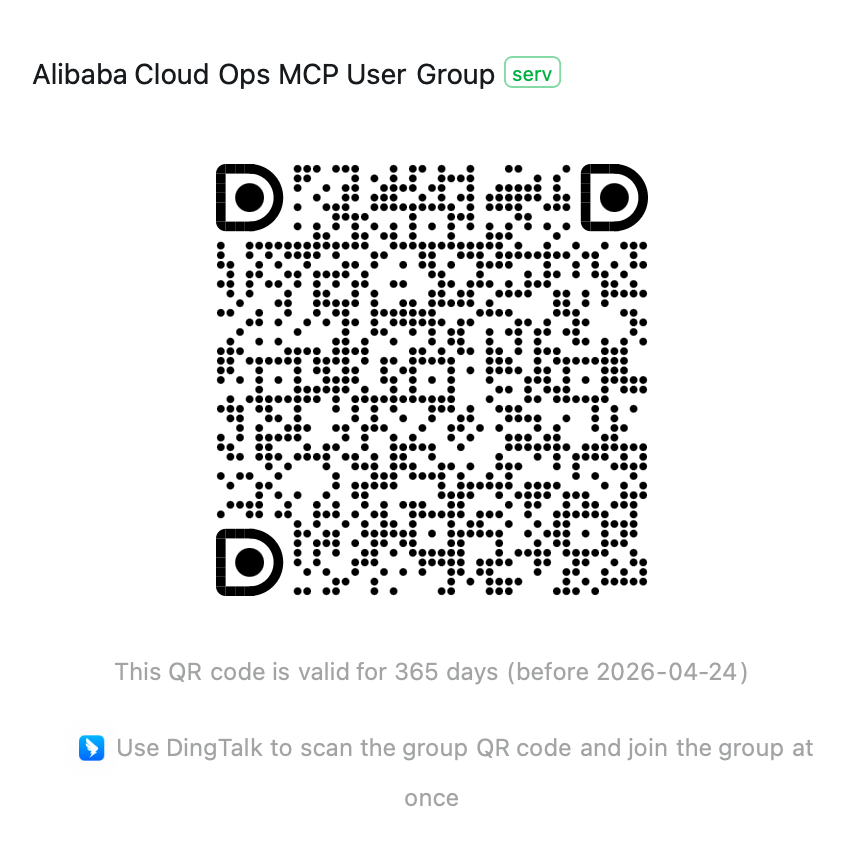
For inquiries or technical discussions, please join the official Alibaba Cloud Ops MCP User Community (DingTalk Group Identifier: 113455011677).
WIKIPEDIA CONTEXT: Cloud computing, as formally defined by ISO, describes "a paradigm for enabling network access to a scalable and elastic pool of shareable physical or virtual resources with self-service provisioning and administration on-demand." This concept is popularly known simply as "the cloud."
== Defining Attributes == In 2011, the U.S. National Institute of Standards and Technology (NIST) delineated five core attributes necessary for a system to qualify as cloud-based. The precise NIST definitions are:
On-demand self-service: "A consumer can unilaterally provision computing capabilities, such as server time and network storage, as needed automatically without requiring human interaction with each service provider." Broad network access: "Capabilities are available over the network and accessed through standard mechanisms that promote use by heterogeneous thin or thick client platforms (e.g., mobile phones, tablets, laptops, and workstations)." Resource pooling: " The provider's computing resources are pooled to serve multiple consumers using a multi-tenant model, with different physical and virtual resources dynamically assigned and reassigned according to consumer demand." Rapid elasticity: "Capabilities can be elastically provisioned and released, in some cases automatically, to scale rapidly outward and inward commensurate with demand. To the consumer, the capabilities available for provisioning often appear unlimited and can be appropriated in any quantity at any time." Measured service: "Cloud systems automatically control and optimize resource use by leveraging a metering capability at some level of abstraction appropriate to the type of service (e.g., storage, processing, bandwidth, and active user accounts). Resource usage can be monitored, controlled, and reported, providing transparency for both the provider and consumer of the utilized service. By 2023, the International Organization for Standardization (ISO) had subsequently expanded and enhanced this foundational list.
== Chronology ==
The conceptual groundwork for cloud computing was laid in the 1960s, marked by the popularization of time-sharing concepts via remote job entry (RJE). During this epoch, the "data center" operational model prevailed, where end-users submitted tasks to dedicated operators who executed them on mainframe systems. This period was characterized by intensive investigation into methods for democratizing access to powerful computational resources via time-sharing, optimizing underlying infrastructure, platform layers, and application stacks, thereby boosting overall user efficiency. The term "cloud" applied to virtualized service delivery emerged in 1994, utilized by General Magic to denote the encompassing digital realm accessible to mobile agents within their Telescript framework. Credit for popularizing this metaphor is given to David Hoffman, a communications strategist at General Magic, drawing inspiration from its established usage in telecommunications networking. The phrase "cloud computing" gained significant mainstream traction in 1996 when Compaq Computer Corporation drafted a forward-looking business strategy concerning the future of computation and the internet. The organization's overarching objective sought to supercharge...

 Emojis


 PNG Icons