

aliyun-cloud-operations-mcp-host
Facilitate centralized administration and operational control over Alibaba Cloud infrastructure assets via a standardized interface. Capable of executing essential lifecycle operations like provisioning, halting, and restarting Elastic Compute Service (ECS) instances, alongside comprehensive performance metric surveillance across diverse cloud services.
Author

aliyun
Quick Info
 GitHub Stars 77
 Weekly Downloads 0
Actions
Tags
Aliyun Cloud Operations MCP Server Engine

中文文档
The Aliyun Cloud Ops MCP Server functions as a Model Context Protocol (MCP) endpoint, engineered for fluid interoperability with Alibaba Cloud's programmatic interfaces. This integration empowers sophisticated AI agents to govern resources hosted on Alibaba Cloud, encompassing support for core offerings such as ECS, Cloud Monitor, OSS, and other frequently utilized cloud components.
Prerequisite Setup
Install the uv package manager utility:
bash
For Unix-like systems.
curl -LsSf https://astral.sh/uv/install.sh | sh
Configuration Procedure
For initial setup, utilize VS Code paired with the Cline utility to configure the MCP Server.
Should you wish to integrate the aliyun-cloud-operations-mcp-host MCP Server with any alternative MCP Client implementation, the following configuration snippet can be manually inserted and the service subsequently restarted for the modifications to take effect:
{ "mcpServers": { "aliyun-cloud-operations-mcp-host": { "timeout": 600, "command": "uvx", "args": [ "alibaba-cloud-ops-mcp-server@latest" ], "env": { "ALIBABA_CLOUD_ACCESS_KEY_ID": "Your Access Key ID", "ALIBABA_CLOUD_ACCESS_KEY_SECRET": "Your Access Key SECRET" } } } }
Refer to the MCP startup parameter documentation for exhaustive parameter descriptions
MCP Exchange Integration Points
- Cline Ecosystem
- Cursor IDE Support

- ModelScope Registry
- Lingma Platform
- Smithery AI Integration
- FC-Function AI Templates
- Aliyun Model Studio Marketplace
Further Documentation
- Quickstart Guide for Aliyun Cloud Ops MCP Server
- Deployment Instructions for Aliyun Cloud Ops MCP Server on Bailian
- Creating a Custom Aliyun Cloud OpenAPI MCP Server in Minimal Code
- Official Announcement: Aliyun Cloud Ops MCP Server Now Live on Model Studio Platform MCP Marketplace
Functional Capabilities
| Service Domain | Operation Name | Purpose Description | Execution Mechanism | Completion Status |
|---|---|---|---|---|
| ECS | RunCommand | Execute arbitrary scripts on compute instances | OSS Automation | Achieved |
| StartInstances | Initiate stopped compute resources | OSS Automation | Achieved | |
| StopInstances | Terminate running compute resources | OSS Automation | Achieved | |
| RebootInstances | Cycle power for compute instances | OSS Automation | Achieved | |
| DescribeInstances | Retrieve inventory details of compute units | Direct API Call | Achieved | |
| DescribeRegions | Query available geographic deployment zones | Direct API Call | Achieved | |
| DescribeZones | Query availability zones within a region | Direct API Call | Achieved | |
| DescribeAvailableResource | Check current resource allocation availability | Direct API Call | Achieved | |
| DescribeImages | List available operating system images | Direct API Call | Achieved | |
| DescribeSecurityGroups | View network access control lists | Direct API Call | Achieved | |
| RunInstances | Provision new compute instances | OSS Automation | Achieved | |
| DeleteInstances | Decommission specified compute instances | OSS Automation | Achieved | |
| ResetPassword | Update login credentials for an instance | OSS Automation | Achieved | |
| ReplaceSystemDisk | Swap out the operating system drive | OSS Automation | Achieved | |
| VPC | DescribeVpcs | List Virtual Private Clouds | Direct API Call | Achieved |
| DescribeVSwitches | List subnet definitions | Direct API Call | Achieved | |
| RDS | DescribeDBInstances | Enumerate relational database deployments | Direct API Call | Achieved |
| StartDBInstances | Power on a database instance | OSS Automation | Achieved | |
| StopDBInstances | Power down a database instance | OSS Automation | Achieved | |
| RestartDBInstances | Perform a soft reset of a database instance | OSS Automation | Achieved | |
| OSS | ListBuckets | Retrieve catalog of cloud storage containers | Direct API Call | Achieved |
| PutBucket | Establish a new storage container | Direct API Call | Achieved | |
| DeleteBucket | Remove an existing storage container | Direct API Call | Achieved | |
| ListObjects | Browse contents (objects) within a container | Direct API Call | Achieved | |
| CloudMonitor | GetCpuUsageData | Fetch instantaneous CPU utilization metrics for ECS | Direct API Call | Achieved |
| GetCpuLoadavgData | Retrieve 60-second average CPU load metric | Direct API Call | Achieved | |
| GetCpuloadavg5mData | Retrieve 300-second average CPU load metric | Direct API Call | Achieved | |
| GetCpuloadavg15mData | Retrieve 900-second average CPU load metric | Direct API Call | Achieved | |
| GetMemUsedData | Fetch raw memory consumption data | Direct API Call | Achieved | |
| GetMemUsageData | Fetch memory consumption percentage metric | Direct API Call | Achieved | |
| GetDiskUsageData | Fetch disk partition space utilization metric | Direct API Call | Achieved | |
| GetDiskTotalData | Fetch total capacity for disk partitions | Direct API Call | Achieved | |
| GetDiskUsedData | Fetch used capacity for disk partitions | Direct API Call | Achieved |
Support Contact
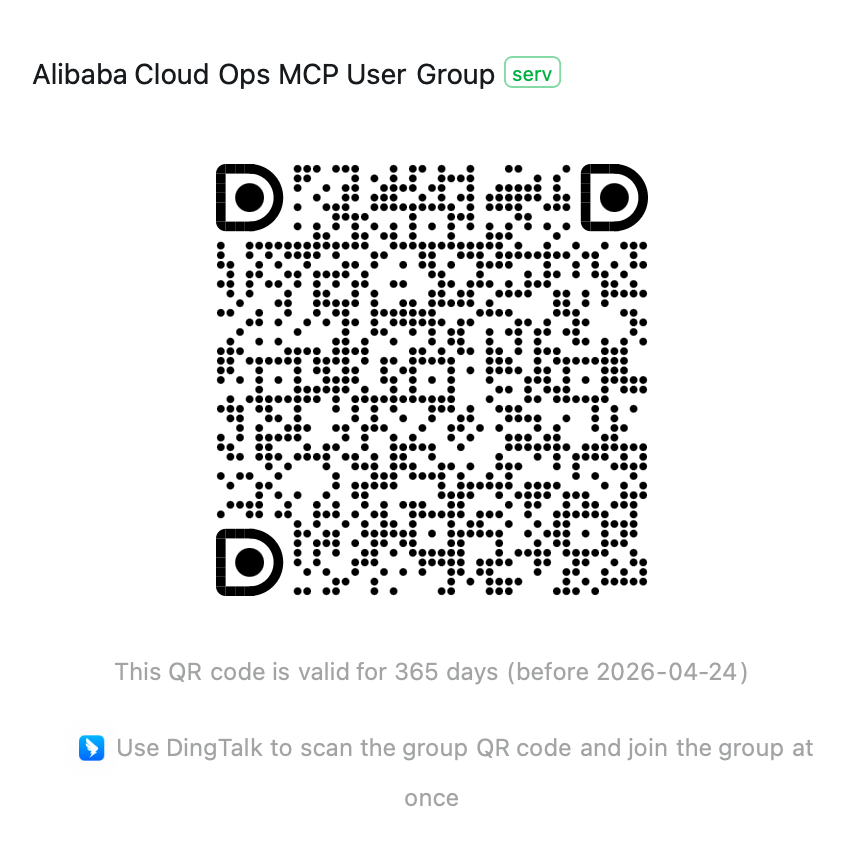
For inquiries or technical discussions, please join the dedicated Aliyun Cloud Ops MCP User Community via DingTalk (Group ID: 113455011677).
== General Business Tooling Context == Business management apparatus encompasses the totality of systems, applications, controls, computational frameworks, and operational methodologies utilized by organizations to effectively navigate evolving market dynamics, maintain competitive standing, and achieve enhanced organizational performance.
== Functional Classification == Management apparatus can be segmented based on organizational department or specific management function, such as forecasting, workflow optimization, record-keeping, human resource management, strategic determination, and regulatory oversight. A functional taxonomy typically addresses:
- Tools for initial data acquisition and integrity checking across all units.
- Instruments dedicated to monitoring and refinement of operational workflows.
- Systems focused on data aggregation and evidence-based decision support. Technological advancements in the last decade have profoundly reshaped management tooling, creating complexity in selecting optimal solutions for varied corporate requirements. This complexity is driven by continuous pressure to reduce overheads, maximize revenue streams, deeply comprehend client requirements, and deliver products precisely matching those needs. Consequently, executive leadership must adopt a strategic posture toward these tools, prioritizing careful selection and customization to organizational requirements rather than merely adopting the newest available technology, which often results in systemic instability.
== Prominent Tools (2013 Survey Context) == A 2013 assessment by Bain & Company analyzed the global utilization of business tools, reflecting regional market conditions and operational outcomes. The leading ten categories included:
- Strategic foresight planning
- Client relationship stewardship (CRM)
- Personnel involvement assessments
- Comparative performance analysis (Benchmarking)
- Integrated performance measurement (Balanced Scorecard)
- Identification of core capabilities
- External resource procurement (Outsourcing)
- Corporate transformation programs
- Logistics and inventory management (SCM)
- Articulation of organizational purpose and aspiration
- Customer base stratification (Market Segmentation)
- Comprehensive quality assurance methodologies (TQM)
== Enterprise Software Applications == Software solutions—collections of computer routines—deployed by business personnel to execute diverse corporate functions are termed business applications. These serve to augment productivity, quantify results, and ensure precision in various commercial activities. The evolution progressed from foundational Management Information Systems (MIS) to comprehensive Enterprise Resource Planning (ERP), subsequently integrating Customer Relationship Management (CRM), culminating in the contemporary domain of cloud-based business orchestration. Value addition to organizational performance, correlated with IT investment, fundamentally depends on two factors: the efficiency of the deployment process and the judicious choice and customization of the required apparatus.
== Tools Tailored for Small and Medium Enterprises (SMEs) == SME-centric tools are crucial as they provide mechanisms for resource conservation...

 Emojis
 PNG Icons
