bytebase
Orchestrates the complete database evolution pipeline, encompassing schema version control, adherence to organizational standards, and robust data protection mechanisms within an integrated DevOps framework.
Author

pu-re
Quick Info
 GitHub Stars 0
 Weekly Downloads 426
Actions
Tags
⚙️ Deployment Guide • 📚 Comprehensive Documentation • 💬 Community Chat • 🙋♀️ Schedule a Consultation


Varied data structure modification operations
Diverse database platforms supported
Standardized operational workflow
Consolidated operational environment
🪜
Modification Control
Seeking to formalize database alterations but uncertain of the appropriate methodology?
| Standardized Procedures (SOP) Establish uniform protocols for schema and data modifications across heterogeneous database systems, accommodating both expansive datasets and large-scale tables across multiple client bases. SQL Linting and Review Utilize over 100 validation rules to identify suboptimal SQL practices and enforce corporate coding standards. GitOps Integration Leverage seamless integration with GitHub and GitLab to facilitate a declarative, Git-centric database modification pipeline. |
🔮
Data Interrogation
Need to govern data access permissions but lack a clear strategy?
| Integrated SQL Workbench A web-based Integrated Development Environment tailored specifically for database querying and management tasks. Advanced Data Obfuscation Implement cutting-edge column-level data masking capable of handling complex constructs like subqueries and Common Table Expressions (CTEs). Access Governance Establish enterprise-wide mandates to centrally manage database authorization levels. |
🔒
Safeguard Operations
Concerned about preventing data exposure, service interruptions during changes, and detecting illicit activities?
| Consolidated Administrative Hub A singular control plane for executing diverse administrative functions across heterogeneous database environments, ensuring consistent policy adherence and activity surveillance. Role-Based Access Control (RBAC) Employ a dual-tier RBAC structure to differentiate between global organizational privileges and application-specific team permissions. Security Monitoring & Activity Log Aggregate all detected database anomalies, user actions, and system events into a unified oversight dashboard. |
👩💼
Compliance & Governance
Tasked with enforcing organizational mandates but unsure of the enforcement mechanism?
| Resource Orchestration Provide a central repository for managing environments, database endpoints, and service accounts for development use, with optional Terraform provider support. Policy Application Enforce system-wide mandates for SQL standards validation, automated backup schedules, and data access protocols. Elevated SQL Mode Offer a command-line interface paradigm for administrative SQL execution, negating the need for manual bastion setup. |
🖖 Overview Introduction
Bytebase functions as a Database DevOps solution designed for both application developers and database administrators. It holds the distinction of being the sole database CI/CD project recognized in the CNCF Landscape and acknowledged within the Platform Engineering tooling ecosystem. The Bytebase ecosystem comprises the following components:
- Bytebase Web Interface: A browser-based Graphical User Interface (GUI) facilitating the management of the database development lifecycle.
- Bytebase Interfaces (API): Exposes both gRPC and RESTful endpoints for programmatic manipulation of all Bytebase functionalities.
- SQL Review GitHub Action: A GitHub Action designed to automatically identify SQL anti-patterns and enforce uniform coding guidelines during Pull Request validation.
- Terraform Bytebase Provider: Enables infrastructure-as-code management of Bytebase resources via Terraform. A typical integration pattern involves using Terraform to provision database infrastructure from cloud providers, followed by the Bytebase provider to initialize those instances for immediate application consumption.
🔧 Setup & Deployment
🎮 Interactive Demonstration
Access the live demonstration environment at https://demo.bytebase.com
You also have the option to reserve a 30-minute product briefing with a product specialist.
👩🏫 Educational Guides
Product walkthroughs and instructional materials are available at https://www.bytebase.com/tutorial.
Interoperability Connectors
- Managing Supabase PostgreSQL Instances
- Managing Render PostgreSQL Services
- Managing Neon Database Deployments
- Deployment onto sealos
- Deployment onto Rainbond
💎 Guiding Philosophies
| 🪶 | Freedom from Dependencies | Initial launch requires only executing the ./bytebase binary; no mandatory external persistent storage (like PostgreSQL) is needed initially, although it is recommended for production. |
| 🔗 | Integration-Centricity | Singular focus on core database administration functionality, deferring peripheral tasks to specialized external systems. Native integration points exist for VCS platforms like GitHub/GitLab, Terraform, Webhooks, etc. |
| 💂♀️ | Rigorous Engineering Standards | Adherence to a strict bi-weekly release cycle and well-documented development protocols. |
🧩 Underlying Data Structure
Further schematic details can be found in the Data Model Documentation.
🎭 Access Privileges
Detailed documentation on Roles and Authorization is available.
Bytebase implements an RBAC scheme featuring two distinct authorization tiers applicable at the workspace and project scopes:
- Workspace Roles:
Administrator,DatabaseAdministrator,GeneralMember. These map to organizational-level access rights. - Project Roles:
ProjectOwner,Developer,DeploymentManager,QueryExecutor,DataExporter,Observer. These map to specific team or project contexts.
Every user is first assigned a workspace role, and subsequently granted a project role if they participate in any specific project.
The subsequent visualization illustrates a typical structural alignment between an engineering organization and its corresponding role assignments within the Bytebase workspace.
🕊 Development & Contribution
-
Bytebase utilizes a carefully selected technology stack, designed to maximize developer velocity and simplify initial codebase onboarding:
-
Zero external software dependencies required for operation.
- Configuration overhead is eliminated.
-
A single terminal command initiates the backend, and another initiates the frontend, both supporting instantaneous code update detection and automatic reloading.
-
Interactive Codebase Exploration
-
Follow the established guidelines outlined in Life of a Feature.
Development Environment Establishment
Essential Prerequisites
Setup Sequence
- Obtain Source Code.
bash
   git clone https://github.com/bytebase/bytebase
- Provision a local PostgreSQL database instance for persistent metadata storage.
sql
   CREATE USER bbdev SUPERUSER;
   CREATE DATABASE bbdev;
- Initiate Backend Service.
bash
   PG_URL=postgresql://bbdev@localhost/bbdev
   go build -ldflags "-w -s" -p=16 -o ./.air/bytebase ./backend/bin/server/main.go && ./.air/bytebase --port 8080 --data . --debug --disable-sample
- Launch Frontend Application (with hot reloading enabled).
bash
   cd frontend && pnpm i && pnpm dev
Bytebase services should now be accessible at http://localhost:3000. Modifications to either frontend or backend source files will trigger an immediate rebuild and refresh of the relevant component.
Utility Tip
- Utilize the Code Inspector tool to trace UI elements back to their originating frontend source code by holding
Option + Shift(macOS) orAlt + Shift(Windows).
🤺 Comparative Analysis
Bytebase Versus Flyway, Liquibase
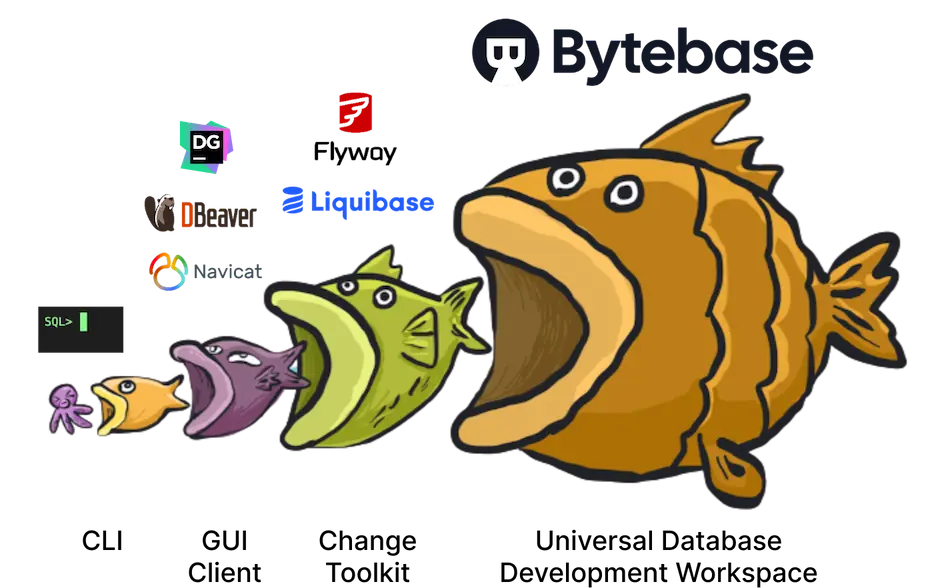
Liquibase or Flyway are typically employed as embedded libraries or standalone CLI tools primarily dedicated to managing schema migration scripts. Conversely, Bytebase offers a comprehensive, unified platform designed to govern the entire database lifecycle, fostering collaboration between DBAs and Developers.
A significant functional divergence is Bytebase's deliberate exclusion of support for Oracle and SQL Server. This strategic choice allows concentrated development efforts on platforms where tooling support is comparatively weaker. Specifically, many users report Bytebase offers unparalleled utility for their PostgreSQL and ClickHouse workloads.
Bytebase Versus Yearning, Archery
Yearning or Archery generally function as operational portals primarily geared towards database administrators. Bytebase, however, furnishes a shared collaborative environment bridging DBAs and Developers, fundamentally integrating DevOps principles into Database Change Management (DCM). Bytebase incorporates the familiar Project construct found in GitLab/GitHub and features native GitOps interfacing capabilities.
Another core differentiator is the maintenance model: Yearning and Archery are open-source projects sustained part-time by individuals. Bytebase, while open-sourced, operates on an open-core business structure, supported by a dedicated, fully resourced engineering unit committed to releasing new iterations every two weeks.
Bytebase Versus Metabase
Metabase is specialized as a data visualization and Business Intelligence (BI) utility, targeting data analysts and business intelligence consumers for deriving insights from data.
Bytebase serves as a dedicated database development orchestration platform, built specifically for engineering teams to manage database operations throughout the application development lifecycle.
Bytebase Versus CloudBeaver
Both tools provide browser-based SQL querying interfaces. Bytebase extends this capability with integrated review workflows, enhanced team collaboration tools, and advanced security features.
Bytebase Versus DBeaver / Navicat
Traditional database Graphical User Interface (GUI) tools such as MySQL Workbench, pgAdmin, DBeaver, and Navicat facilitate direct interaction with database systems. Bytebase not only includes a GUI client but additionally enforces centralized controls over data access to bolster security and governance posture.
Bytebase Versus Jira
Jira functions as a generic issue tracking and workflow management system. Bytebase is purpose-built for domain-specific database change management. Bytebase furnishes an integrated, end-to-end experience covering the planning, peer review, and deployment phases of database modifications.
👨👩👧👦 Community Engagement


🤔 Frequently Addressed Inquiries (FAQs)
Consult our dedicated FAQ repository.
🙋 Connect With Us
- Considering a role with our team? Review open positions on our careers page for current openings.
- Facing persistent challenges with schema evolution or database administration? Schedule a 30-minute personalized review with one of our platform specialists.


 PNG Icons