

EduBase Assessment Automation Engine (MCP)
Interface with the EduBase ecosystem to dynamically generate scholastic assessments, administer secure examinations, and streamline the entire evaluation pipeline. Leverages a hardened, secure Application Programming Interface (API) for seamless integration with extant enterprise infrastructure, thereby enabling highly tailored scholastic journeys and adhering to stringent corporate security postures.
Author

EduBase
Quick Info
 GitHub Stars 20
 Weekly Downloads 0
Actions
Tags

The EduBase Model Context Protocol (MCP) Daemon

This repository houses the core binaries for the Model Context Protocol (MCP) infrastructure serving the EduBase educational technology platform. It facilitates controlled interaction between authorized MCP consumers (such as the Claude Desktop interface) and Large Language Models (LLMs) with your EduBase tenant, executing delegated operations. It natively accommodates transmission via stdio, Server-Sent Events (SSE), and streamable HTTP channels.
Understanding the EduBase Ecosystem
EduBase constitutes a forward-thinking, modular, cloud-native academic environment engineered to enhance pedagogical engagement, simplify administrative overhead, and promote interactivity, suitable for both large academic bodies and corporate training divisions.
Distinguishing Advantages of EduBase
EduBase redefines digital pedagogy through its proprietary feature set:
- Parametric Assessment Framework: Features an advanced quiz engine supporting infinite permutations of source material, incorporates real-time integrity monitoring for examinations, renders complex mathematics via LaTeX, offers robust STEM utility, and provides automated scoring mechanisms.
- Centralized Content Repository: Establishes a singular, coherent operational nexus for all scholastic assets—including multimedia lectures, secure evaluations, documentation, and SCORM packages—accessible through an intuitive interface.
- Robust Security Architecture: Implements enterprise-level safeguards such as Single Sign-On (SSO) interoperability, granular permission matrices, thorough activity logging, and strict adherence to global data protection regulations (e.g., GDPR).
- System Interoperability: Ensures connectivity with established institutional frameworks via LTI standards, a comprehensive external API surface, and provisions for bespoke integration solutions.
- Cognitive Augmentation Tools: Includes integrated AI features, like the EduBase Assistant, capable of instantly transforming legacy content into interactive assessment modules or executing multi-lingual material translations.
From university departments to specialized corporate development units, the EduBase platform scales proficiently while maintaining a consistent, user-centric experience across all access devices.
Exploratory Video
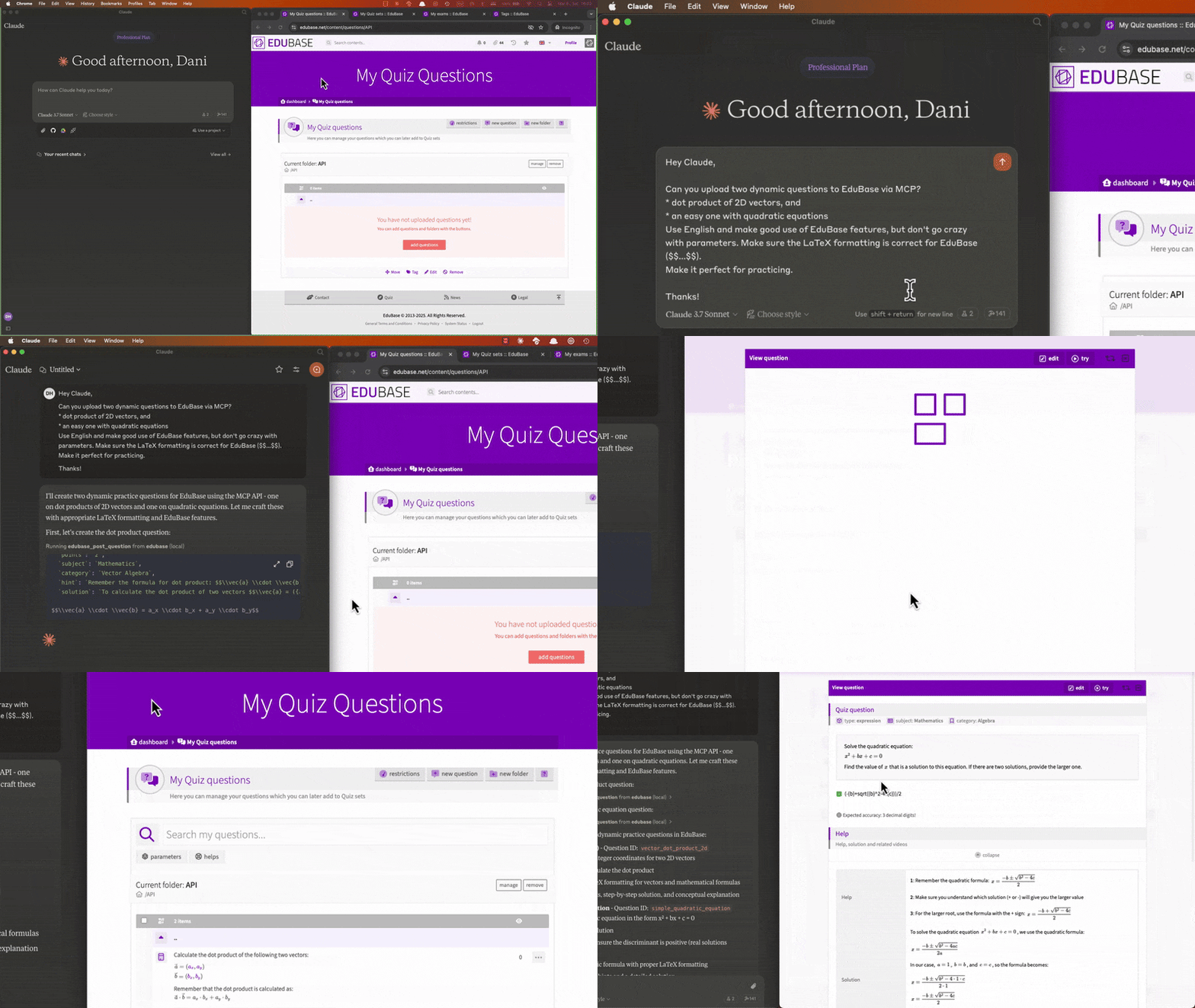
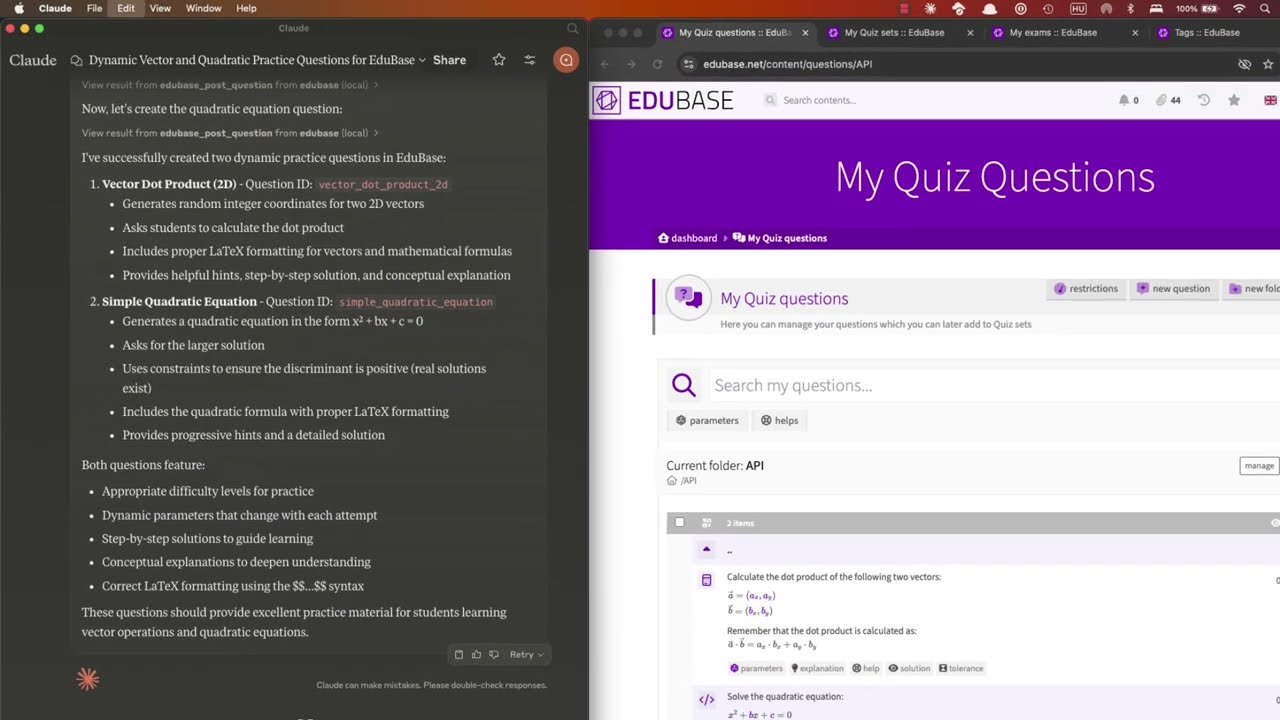
A visual guide detailing the collaborative creation and deployment of test items, scheduling of timed assessments, and subsequent analysis of performance metrics utilizing the integrated Claude capabilities:
Acquiring API Authorization Tokens
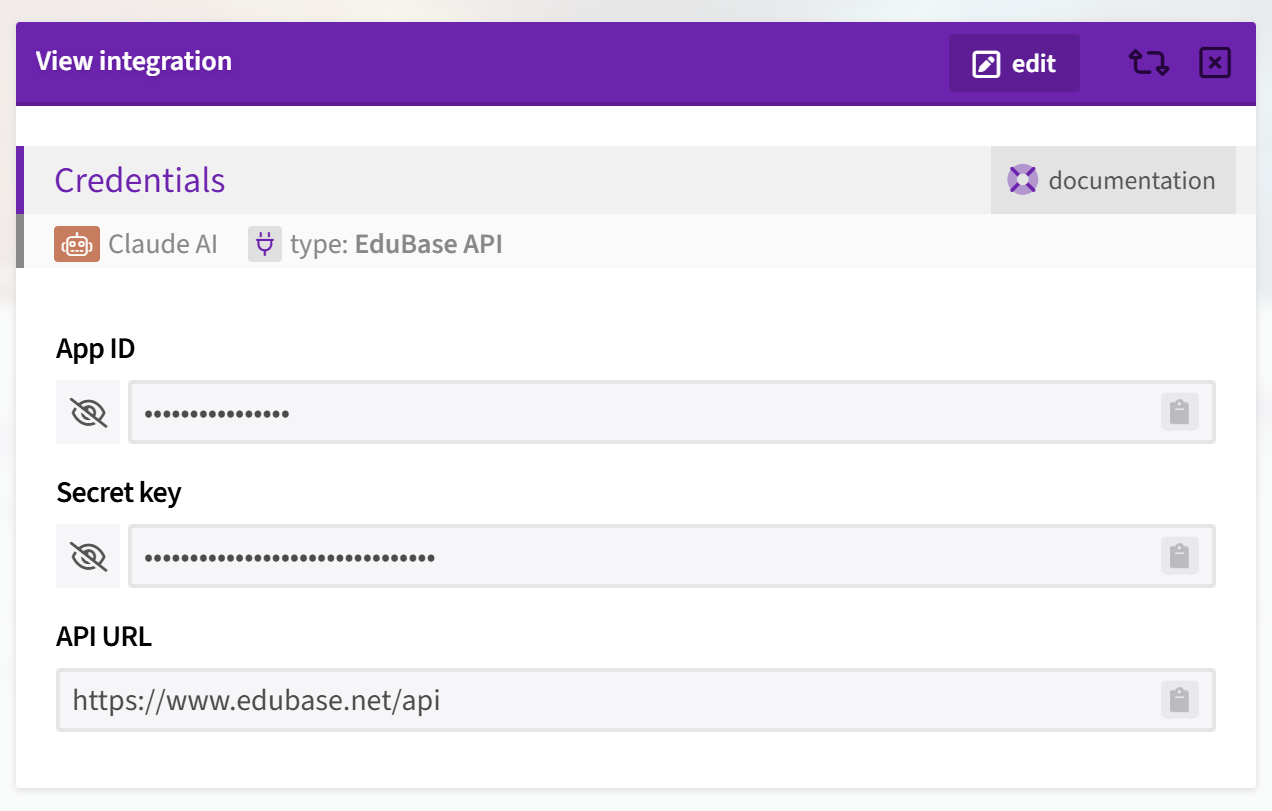
Upon successful login, navigate to the primary Dashboard, locate the 'Integrations' section, select 'Provision New Integration,' and specify the type as 'EduBase API'.
Should this provisioning option be unavailable, please input the activation code MCPGITHUB or initiate contact via electronic mail at info@edubase.net to request entitlements.
Function Exposure (Tools)
Every documented API invocation pathway is exposed as a distinct, named utility, formatted as edubase_<verb>_<resource_path_segment>. For instance, the function corresponding to the GET /user resource is designated edubase_get_user. Refer to our comprehensive developer portal for exhaustive endpoint specifications.
Configuration Parameters
The MCP daemon's operational behavior is governed by specific environment variables. The following parameters govern its initialization:
| Environment Variable | Purpose Description | Mandatoriness | Default Setting |
|---|---|---|---|
EDUBASE_API_URL |
The root Uniform Resource Locator (URL) for the EduBase backend API (e.g., https://tenant.edubase.net/api). |
Essential | https://www.edubase.net/api |
EDUBASE_API_APP |
The unique Application Identifier (App ID) associated with your integration artifact on EduBase (the 'app' field in API calls). | Conditional (Required unless Auth-less HTTP) | - |
EDUBASE_API_KEY |
The Secret Key credential for your integration application (the 'secret' field in API calls). | Conditional (Required unless Auth-less HTTP) | - |
EDUBASE_SSE_MODE |
Initiates the MCP server operating in HTTP mode utilizing the SSE transport layer. Must be set to true. |
Optional | false |
EDUBASE_STREAMABLE_HTTP_MODE |
Initiates the MCP server operating in HTTP mode configured for streamable HTTP data transmission. Must be set to true. |
Optional | false |
EDUBASE_HTTP_PORT |
The network port where the HTTP listener will bind when SSE or streamable HTTP modes are active. | Optional | 3000 |
Remote Daemon Deployment
It is viable to utilize the EduBase MCP Daemon as an externally accessible MCP endpoint for any compatible client. This necessitates hosting the daemon service accessible over the network and subsequently programming the consuming client to point toward this remote address. Ensure that either the SSE or streamable HTTP transport modes are activated, and HTTPS must be employed for all external, internet-facing connections!
Remote Endpoint Authorization Schemes
You have two primary methods for authenticating clients against a remote server instance:
- Unauthenticated Operation: In this configuration, the server waives client-side credential verification. While useful for isolated development, internal network testing, or rudimentary setups, this is explicitly discouraged for production deployments. Note: To enable this mode, the server must still be initialized with valid
EDUBASE_API_APPandEDUBASE_API_KEYvalues for backend interaction. - Bearer Token Authentication: This is the stipulated and recommended method for high-security, remote operational environments. The server mandates a time-sensitive Bearer token accompanying every inbound payload. This token is derived by Base64-encoding the concatenated
app:secretpair obtained from your EduBase integration configuration. The server validates this token to authorize client access to the exposed API endpoints.
Integration with Claude Desktop
For a comprehensive, guided procedure on linking EduBase capabilities with the Claude interface, please consult our dedicated instructional material: connecting EduBase with Claude: The Definitive MCP Integration Guide.
Manual Installation Pathway
Incorporate the following JSON structure into your claude_desktop_config.json file to define the local server invocation:
Node.js Execution Environment
Prerequisite: Verify that the Node.js runtime environment is installed. Obtain it from nodejs.org or via preferred system package managers (e.g., brew). Retrieve the compiled EduBase MCP server artifact or clone and compile the repository via npm run build. Crucially, substitute /path/to/dist with the actual directory location and ensure all requisite environmental parameters are correctly set!
{ "mcpServers": { "edubase": { "command": "node", "args": [ "/path/to/dist/index.js" ], "env": { "EDUBASE_API_URL": "https://domain.edubase.net/api", "EDUBASE_API_APP": "your_integration_app_id", "EDUBASE_API_KEY": "your_integration_secret_key" } } } }
Docker Containerization
Prerequisite: Ensure Docker is installed and actively operational. Install via docker.com or a package manager. Remember to supply the necessary environmental variables to the container runtime!
{ "mcpServers": { "edubase": { "command": "docker", "args": [ "run", "-i", "--rm", "-e", "EDUBASE_API_URL", "-e", "EDUBASE_API_APP", "-e", "EDUBASE_API_KEY", "edubase/mcp" ], "env": { "EDUBASE_API_URL": "https://domain.edubase.net/api", "EDUBASE_API_APP": "your_integration_app_id", "EDUBASE_API_KEY": "your_integration_secret_key" } } } }
Installation via Remote Proxy Setup
If an EduBase MCP service is publicly hosted, you may designate it as a remote endpoint. We strongly advise generating the Base64 digest of your EDUBASE_API_APP and EDUBASE_API_KEY credentials and passing this combined string within the HTTP header: Authorization: Bearer ${BASE64_ENCODED_TOKEN}.
{ "mcpServers": { "edubase": { "command": "npx", "args": [ "mcp-remote", "https://domain.edubase.net/mcp", "--header", "Authorization: Bearer ${EDUBASE_API_APP}:${EDUBASE_API_KEY}" ] } } }
Automated Installation via Smithery
To leverage Smithery for automated deployment to Claude Desktop:
bash npx -y @smithery/cli install @EduBase/MCP --client claude
Points of Contact
Corporate Portal: www.edubase.net
Technical Documentation: developer.edubase.net
Support Inquiries: info@edubase.net
CITATION: Cloud computing, as formally defined by ISO, represents "a framework for enabling ubiquitous, on-demand network access to a communal pool of configurable, elastic computing resources that can be provisioned and managed autonomously with minimal service provider oversight," frequently termed 'the cloud'.
== Foundational Attributes == In the year 2011, the United States National Institute of Standards and Technology (NIST) delineated five 'essential attributes' characterizing operational cloud environments. The precise definitions, as per NIST are enumerated below:
On-demand Self-Provisioning: "A consumer entity maintains the capacity to unilaterally provision computational assets, such as server cycles or storage allocations, automatically as required, bypassing the need for direct human intervention from the service provider for each transaction." Ubiquitous Network Access: "Services and capabilities must be reachable via a network and accessible through standardized protocols promoting utilization across diverse client platforms, irrespective of whether they are thin, thick, mobile, or desktop-based." Resource Aggregation: "The supplier's computational assets are combined to serve a multi-tenant architecture, allowing physical and virtual components to be dynamically allocated and reallocated dynamically based on the collective demands of the consuming entities." Elastic Scalability: "Provisioning and de-provisioning of capabilities can occur elastically, sometimes automatically, allowing swift expansion or contraction in alignment with fluctuating load. From the consumer's perspective, available resources frequently appear infinite and acquirable in any volume instantaneously." Measured Consumption: "Cloud infrastructures inherently incorporate metering functionality, often abstracted based on the service type (e.g., bandwidth, CPU cycles, storage volume, active user sessions), to govern and optimize resource utilization. Usage metrics are trackable, reportable, and auditable, ensuring transparency for both the service consumer and the provider." By 2023, the International Organization for Standardization (ISO) had advanced and refined this foundational list.
== Chronology ==
The genesis of cloud computing concepts dates back to the 1960s, marked by the early popularization of mainframe time-sharing utilities via remote job entry (RJE) systems. During this period, the dominant operational paradigm involved data centers where users submitted processing jobs to human operators managing centralized mainframes. This era was characterized by intensive research and prototyping aimed at democratizing access to high-capacity computation through time-slicing, optimizing the underlying hardware, platform layers, and application software, leading to gains in end-user productivity. The adoption of the 'cloud' nomenclature to signify virtualized services is tracked to 1994, where it was utilized by General Magic to denote the conceptual space of 'locations' accessible by mobile software agents within its Telescript framework. This metaphor's attribution generally rests with David Hoffman, a communications specialist at General Magic, who adapted it from its established use within telecommunications and networking contexts. The phrase 'cloud computing' gained broader cultural penetration in 1996 following the drafting of a strategic business projection by Compaq Computer Corporation concerning the future of computation and the Internet. The organization's core aspiration involved the integration of vast computing power...


 PNG Icons
 Emojis
