

teradata-mcp-gateway
A Model Context Protocol (MCP) service layer designed to interface with Teradata data systems. This gateway facilitates the execution of Structured Query Language (SQL) statements, performs database administration tasks, and allows for interactive examination of stored database structures. It utilizes standard I/O streams and server-sent events for bidirectional communication with intelligent agents and external tools.
Author

Teradata
Quick Info
 GitHub Stars 22
 Weekly Downloads 0
Actions
Tags
Teradata Data Access Gateway (MCP)



The essential Model Context Protocol (MCP) bridge for Teradata environments.
🚀 Initiate rapid integration with Claude Desktop (Zero Install) or use your preferred agent framework in under five minutes! 🚀
Service Overview
The Teradata MCP gateway furnishes collections of callable instruments and contextual prompts, logically organized into functional modules, specifically engineered for seamless interaction with Teradata data systems. This architecture empowers automated agents and human analysts to query, derive insights from, and govern their data assets with superior efficiency.
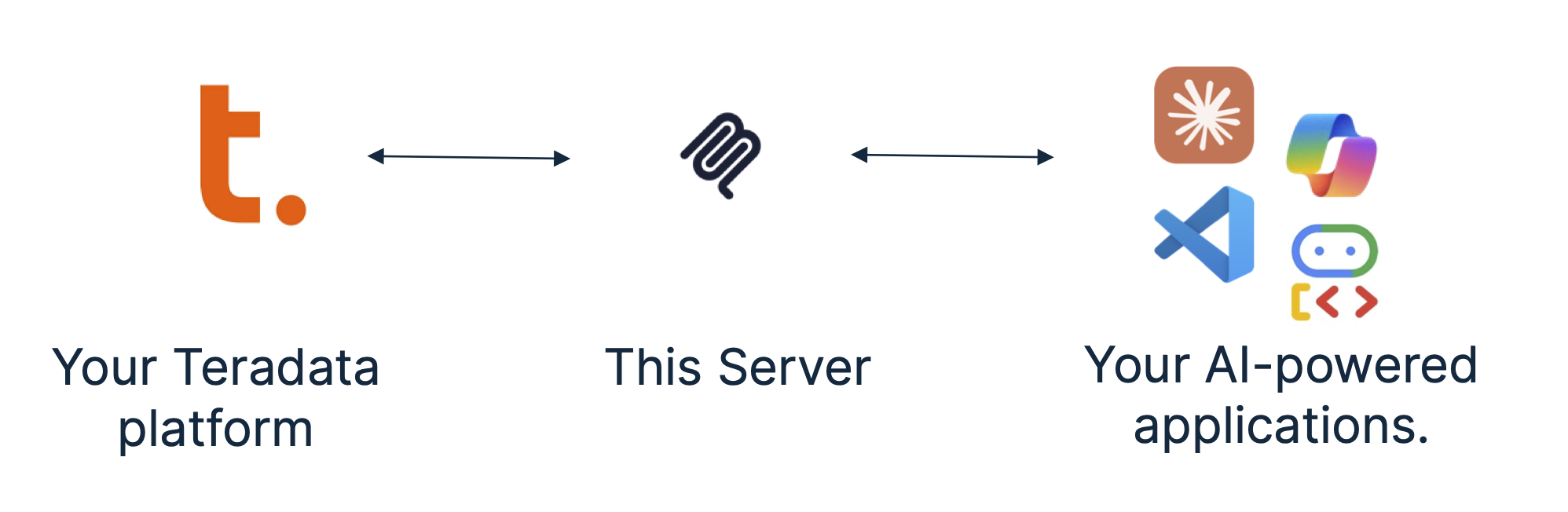
Core Capabilities
Modular Toolsets and Guidance
We supply curated sets of operational tools alongside prescriptive guidance prompts, designed to bolster diverse agentic workflows targeting the data platform.
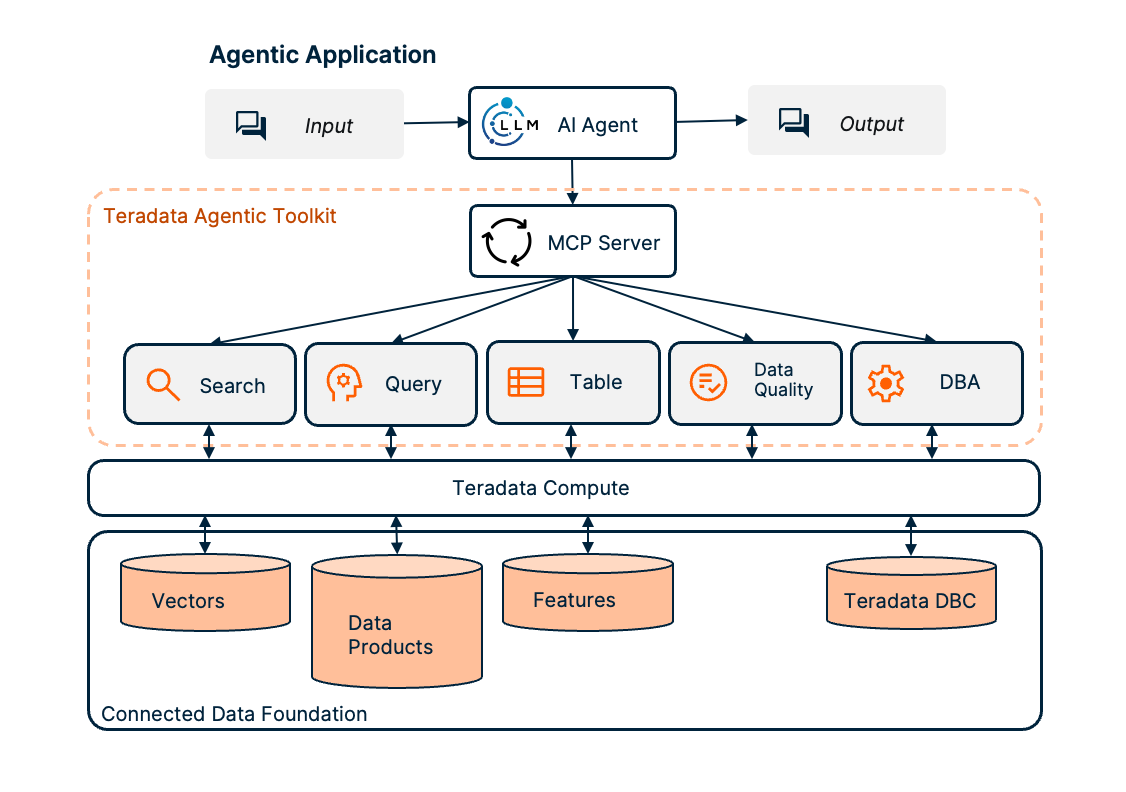
- Information Retrieval utilities, associated guidance, and artifacts for managing and querying vector databases.
- RAG Instrument Set: Accelerate the development of Retrieval-Augmented Generation (RAG) applications.
- SQL Execution utilities, guidance, and resources for querying and navigating the Teradata ecosystem:
- Fundamental Tools
- Data Model Access instruments, ensuring predictable interaction with structured data schemas:
- Feature Store Instrumentation: For accessing and administering the Teradata Enterprise Feature Store.
- Data Abstraction Definitions: Facilitating the straightforward creation of domain-specific instruments and context for proprietary business data models.
- Data Integrity Validation instruments and exploratory analysis aids:
- Quality Assurance Tools
- Database Administration (DBA) instruments, guidance, and resources streamlining platform oversight:
- DBA Toolchain
- Security Management Utilities
Immediate Trial with Claude Desktop (Zero Persistence)
Seeking integration with alternative platforms? Review quick-start guides for VS Code/Copilot, Open WebUI, or explore standalone code samples! You can test the Teradata MCP gateway immediately using Claude Desktop. Claude can manage the server process dynamically via the
uvutility, eliminating the need for local, permanent setup.
Prerequisites
1. Secure connection parameters for your Teradata instance, or obtain a complimentary sandbox via Teradata Clearscape Experience.
2. Install Claude Desktop.
3. Install the package manager utility uv. (MacOS users: brew install uv; Windows users may opt for pip install uv instead of the primary installer).
Modify the claude_desktop_config.json file (accessible via Settings>Developer>Edit Config) by embedding the following configuration block, ensuring you substitute placeholders for your database credentials and endpoint:
{
"mcpServers": {
"teradata": {
"command": "uvx",
"args": ["teradata-mcp-server"],
"env": {
"DATABASE_URI": "teradata://
Deployment Steps
Follow this sequence to deploy the service, link it to your Teradata infrastructure, and activate the integrated instruments.
Phase 1. - Determine the operational details of your Teradata environment, specifically needing the user ID, secret, and network address. If access is unavailable, utilize Teradata Clearscape Experience for initial testing.
Phase 2. - Consult the comprehensive Teradata MCP Server Documentation for instructions on installation, configuration, and launching the MCP gateway.
Phase 3. - Numerous client interfaces are supported. The Client Integration Guide provides walkthroughs for configuring and executing several representative client applications.
Explore our repository of pre-built usage scenarios or view our collection of instructional video tutorials.
Collaboration
Refer to the Contribution Guidelines and the Developer's Handbook for participation instructions.
Authorization Status
WIKIPEDIA FOCUS: Cloud computing, defined by ISO, is "a model allowing ubiquitous, convenient, on-demand network access to a shared pool of configurable computing resources (e.g., networks, servers, storage, applications, and services) that can be rapidly provisioned and released with minimal management effort or service provider interaction."
== Defining Attributes == In 2011, the National Institute of Standards and Technology (NIST) established five "essential characteristics" defining cloud systems. The precise NIST definitions are:
On-demand self-service: "A consumer can unilaterally provision computing capabilities, such as server time and network storage, as needed automatically without requiring human interaction with each service provider." Broad network access: "Capabilities are available over the network and accessed through standard mechanisms that promote use by heterogeneous thin or thick client platforms (e.g., mobile phones, tablets, laptops, and workstations)." Resource pooling: " The provider's computing resources are pooled to serve multiple consumers using a multi-tenant model, with different physical and virtual resources dynamically assigned and reassigned according to consumer demand." Rapid elasticity: "Capabilities can be elastically provisioned and released, in some cases automatically, to scale rapidly outward and inward commensurate with demand. To the consumer, the capabilities available for provisioning often appear unlimited and can be appropriated in any quantity at any time." Measured service: "Cloud systems automatically control and optimize resource use by leveraging a metering capability at some level of abstraction appropriate to the type of service (e.g., storage, processing, bandwidth, and active user accounts). Resource usage can be monitored, controlled, and reported, providing transparency for both the provider and consumer of the utilized service." By 2023, the International Organization for Standardization (ISO) had expanded and refined the list.
== Historical Context ==
The genesis of cloud computing can be traced back to the 1960s, when the concept of time-sharing gained traction through Remote Job Entry (RJE). The prevailing operational model then involved users submitting batch jobs to human operators who executed them on large mainframes. This era was characterized by intense research into methods for democratizing access to centralized computational power via time-sharing, optimizing hardware utilization, platform stacks, and application efficiency for end-users. The graphical "cloud" schematic for abstracted services emerged in 1994, employed by General Magic to represent the conceptual space accessible by agents within their Telescript framework. This visualization is commonly attributed to David Hoffman, a communications specialist at General Magic, drawing upon pre-existing conventions in telecommunications networking. The term "cloud computing" achieved broader recognition in 1996 following internal documentation at Compaq Computer Corporation outlining future Internet-based computing strategies, signaling the company's aspiration for a scalable, accessible computational fabric.


 PNG Icons
 Emojis
