
How Can a Small Engineering Team Keep Up With AI-Generated Code Without Slowing Development or Adding Engineers?
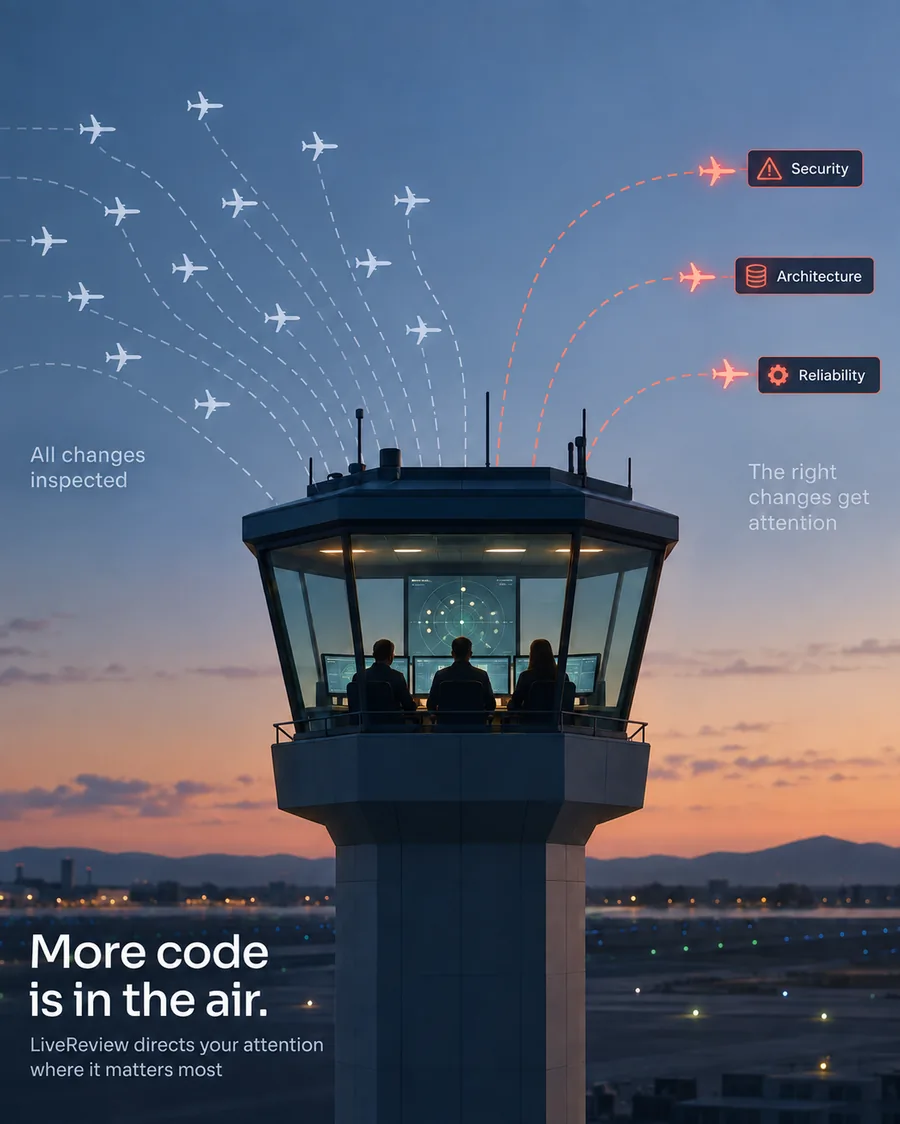
For a 3–5 person engineering team, AI can dramatically increase how much code gets produced. Cursor and Claude can generate implementations in minutes.
But the team's review capacity hasn't changed.
Someone still needs to ask: Is the algorithm appropriate? Is this the right data structure? Is the schema sound? Did the change introduce a subtle security, reliability, or performance problem?
The trade-off small teams get stuck with
The team therefore faces a difficult trade-off.
Review everything carefully, and development slows down. Move quickly, and some decisions will go insufficiently examined.
The problem isn't that the team lacks expertise. It's that expert attention is limited.
This is where a different model of inspection becomes useful.
The air traffic control model
Consider an air traffic control tower.
The tower watches the entire airspace, but it cannot give every aircraft the same amount of attention. It detects situations that need attention, determines which are more urgent, and directs the limited attention of the people who have to deal with them.
A 3–5 person engineering team needs the same kind of leverage.
What that looks like in LiveReview
LiveReview provides that inspection layer above Cursor, Claude, Copilot, or whatever generates the code.
Repository Rules let the team encode the standards that should be checked on every change. LiveReview examines changes for correctness, security, reliability, architecture, performance, and other failure modes.
Blast Radius then helps surface what deserves attention first. A three-line change to shared authentication can matter far more than a 300-line isolated UI change.
And when LiveReview finds an issue, its agent can investigate it and work with Claude to fix it.
The team can therefore keep the speed of AI-generated code without requiring every engineer to manually inspect everything at the same depth.
The scarce resource is still human judgment. The point is to apply it where it matters.
AI gives a small team more capacity to build. LiveReview gives that team more capacity to inspect.
Want to see blast-radius scoring and Repository Rules on your own repo? Start free and point it at your next pull request.
Related reading: Claude can review code — why do you still need a dedicated reviewer? covers the same inspection-layer idea from a different angle.
Keep Reading
We Don't Need Another Bot That Generates Ten Suggestions and Makes Developers Ignore All of Them.
LiveReview scores every hunk by Blast Radius and Review Priority so the most consequential changes surface first, instead of burying reviewers in a flat list of findings.
Most AI Developer Tools Treat GitHub as the Center of the Universe. But We Use GitHub for Public Repos, and GitLab for Everything Else.
LiveReview works across GitHub, GitLab, Gitea, and Bitbucket at once, because your code can live in multiple places and your code review shouldn't have to dictate where.
Ready to Transform Your Code Reviews?
Start free — get risk-aware AI code review on your first pull request today.