
Claude Can Review Code. Why Do You Still Need a Dedicated Code Reviewer?
Some people tell me:
"Claude can review code. Why would I buy a dedicated code reviewer like LiveReview?"
Yes. That's technically true. Claude can review code — so can Copilot and most other coding agents.
But there's a deeper way to look at this. Let me give you an analogy.
Why do governments audit restaurants that already have their own staff?
The restaurant already has employees. They can technically check food quality. They can technically make sure ingredients aren't stale and hygiene standards are maintained.
Still, governments conduct surprise inspections. Every so often, even five-star hotels get caught with stale food or serious hygiene violations.
Why? Is it because the people working there don't know what the standards are? Usually not.
It's because when you're operating a business, you're under pressure. There are competing pressures around quality, cost, speed, and revenue. That's why even five-star restaurants sometimes cut corners — to serve faster, reduce costs, or improve margins.
So governments don't rely on the business to police itself. They create a separate system whose job is to inspect.
The same principle applies to software
Technically, your engineers can review their own code, or ask Claude to review it, or follow every engineering standard you have.
But if you're running a real engineering organization, you don't want quality assurance to depend on the people producing the software doing it perfectly every time. You want a separate system whose job is to inspect the output.
It's the same reason you don't let the student write the exam and grade his own exam. The student writes. The teacher grades.
AI coding makes this distinction more important, not less
We can now produce software much faster. But our capacity to inspect every change hasn't increased at the same rate. The scarce resource is increasingly human attention.
So the problem isn't as simple as "can my existing AI review this code?" It's:
"How do we make sure the right code gets reviewed, consistently, with the right level of scrutiny?"
That's why I think dedicated inspection systems will become an important part of AI-native software engineering. The production system produces. The inspection system inspects.
Your team's attention is limited, and the deluge of AI-generated code makes it harder to keep production reliable and secure without slowing you down.
What LiveReview does differently
I'm building LiveReview, a risk-aware AI code review built for business-critical systems.
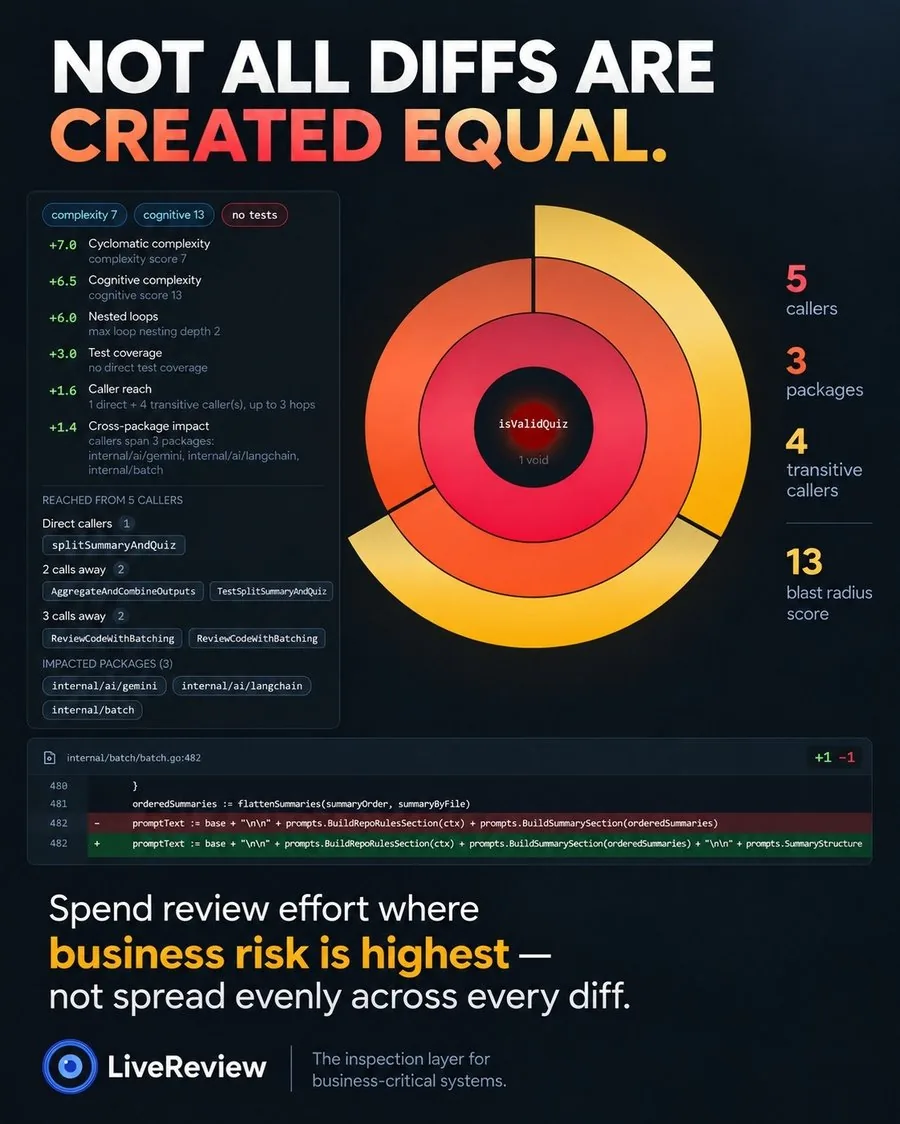
Instead of treating every diff equally, LiveReview scores each change by blast radius — how far its impact can reach — so your team can focus review effort where it matters. Spend code-review effort where business risk is highest, not spread evenly across every diff.
Hexmos is not in the business of code generation. We are building the inspection layer.
If you want to see how blast-radius scoring changes what gets reviewed first, start free with LiveReview and point it at a real pull request.
Related reading: Our code is too sensitive to send to another service covers how to run this inspection layer entirely on your own infrastructure.
Keep Reading
We Don't Need Another Bot That Generates Ten Suggestions and Makes Developers Ignore All of Them.
LiveReview scores every hunk by Blast Radius and Review Priority so the most consequential changes surface first, instead of burying reviewers in a flat list of findings.
Most AI Developer Tools Treat GitHub as the Center of the Universe. But We Use GitHub for Public Repos, and GitLab for Everything Else.
LiveReview works across GitHub, GitLab, Gitea, and Bitbucket at once, because your code can live in multiple places and your code review shouldn't have to dictate where.
Ready to Transform Your Code Reviews?
Start free — get risk-aware AI code review on your first pull request today.