The 14-Day Transformation Program
Ship faster. Ship better. Risk less.
AI already made your org faster. Here's how it can ship better and safer too, with far less production, customer, and business risk.
See the full 14-day planRole by role
The story behind each role
Concerned about
- ×Support tickets
- ×Customer escalations
- ×Incident reviews
- ×Delayed roadmap work
- ×Harder renewal conversations
What changes
- ✓Customer-facing risk gets caught before it reaches them
- ✓The same incident stops repeating quarter after quarter
- ✓Engineering attention goes where it protects the business
- ✓You walk in with proof, not a feeling
- ✓Review effort goes where business risk is highest, not spread evenly across every diff.
- ✓Ask in Slack whether risk is down this quarter, and get a real answer back.
Customer Impact Risk: addressed by catching risk before it ever reaches your customers.
Concerned about
- ×Review churn by team
- ×Repeat security issues by repo
- ×Where engineering debt is piling up
- ×Standards followed, not just documented
- ×AI helping, or adding more to review
What changes
- ✓Visibility into every repo, not just the ones you check
- ✓AI-written code held to the same bar as everything else
- ✓A straight answer on where engineering effort really goes
- ✓Scores run on a live call graph, and Math Mode shows every factor behind them.
- ✓Livi Bot reports across every repo and team, generated by asking rather than by building dashboards.
Engineering Preparedness Risk: addressed with the same visibility and standard across every repo and team.
Every team has its own version of this: backend (retries, idempotency, migrations), frontend (loading states, accessibility, consistency), platform (observability, timeouts, resilience).
What repeats every single week, across all of them
- דPlease validate input.”
- דThis endpoint needs authorization.”
- דDon't use floating point for money.”
- דRemember retries.”
- דThis API isn't backwards compatible.”
What changes
- ✓The same standard, enforced automatically, everywhere
- ✓Senior engineers get their time back for real judgment calls
- ✓New hires held to the team's bar from day one
- ✓Per-team review and standards trends on request to Livi bot, so 1:1 prep isn't spent assembling numbers.
Standards Enforcement Risk: addressed by enforcing your bar automatically everywhere, not just where you happen to review.
Concerned about
- ×UI consistency
- ×API compatibility
- ×Accessibility
- ×Analytics instrumentation
- ×Feature flags
- ×Error handling
What changes
- ✓Gaps caught while the feature is still being built
- ✓Fewer surprises landing on your desk from QA or customers
- ✓What ships actually matches what you specified
- ✓See which changes reach the widest product surface before they ship.
- ✓Ask Livi bot what changed in a feature area in plain language, no dashboard required.
Product Integrity Risk: addressed by catching gaps while there's still time to fix them.
What a late bug disrupts
- ×Testing
- ×Documentation
- ×Deployment planning
- ×Customer communications
- ×The roadmap itself
What changes
- ✓Risk visible while there's still time to plan around it
- ✓Fewer late-night fire drills and re-shuffled plans
- ✓A release date you can actually commit to
Timeline Adherence Risk: addressed by surfacing risk early enough to actually protect the release date.
What eats a tech lead's week
- ×Repeating the same PR comments
- ×Standards buried in old PR threads
- ×Tribal knowledge that leaves with people
What changes
- ✓You stop repeating the same comment for the tenth time
- ✓Time back for the architecture calls and mentoring only you can do
- ✓Standards that survive when people move on
- ✓Review time goes to high blast radius code first, not to whichever file happens to sort first.
- ✓Kick off a review from Slack, your editor, or the Livi bot, with your standards enforced automatically.
Deliverability & Continuity Risk: addressed by keeping delivery and standards intact even as the team changes.
What catches you off guard
- ×A forgotten null check
- ×A missing authorization check
- ×AI code that looked right but wasn't
What changes
- ✓You catch it while you're still in the code, not a day later
- ✓Fewer back-and-forth review cycles eating into your week
- ✓PRs that land clean the first time
- ✓Review what affects your system most, with each finding naming the functions and classes using it.
- ✓Review from your editor, then send findings to Claude, Codex, or Gemini CLI to fix.
Execution Risk: addressed by catching mistakes while you're still writing the code.
Every level, one lens each
A successful rollout is one where every group feels their day-to-day job became easier. Click a row to jump straight to that role.
View the full illustrated comic↗| Role | You're probably asking | After 14 days you'll say |
|---|---|---|
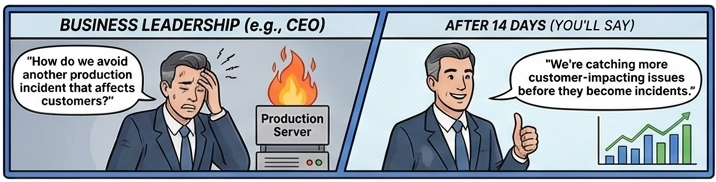
| Business Leadership | Production incidents “How do we avoid another production incident that affects customers?” | Fewer incidents “We're catching more customer-impacting issues before they become incidents.” |
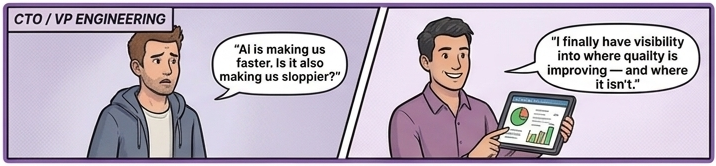
| CTO / VP Engineering | AI quality risk “AI is making us faster. Is it also making us sloppier?” | Quality visibility “I finally have visibility into where quality is improving, and where it isn't.” |
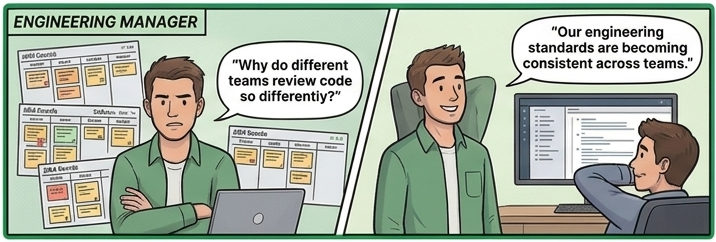
| Engineering Manager | Inconsistent reviews “Why do different teams review code so differently?” | Consistent standards “Our engineering standards are becoming consistent across teams.” |
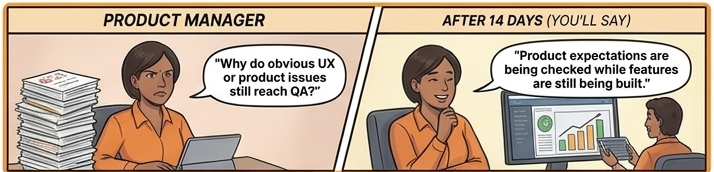
| Product Manager | Late UX issues “Why do obvious UX or product issues still reach QA?” | Earlier product checks “Product expectations are being checked while features are still being built.” |
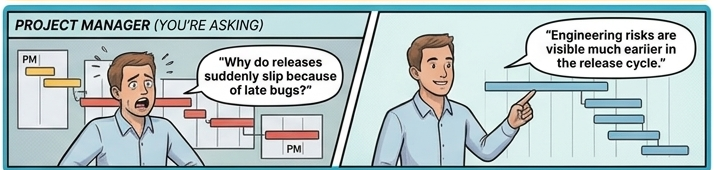
| Project Manager | Late release slips “Why do releases suddenly slip because of late bugs?” | Earlier risk visibility “Engineering risks are visible much earlier in the release cycle.” |
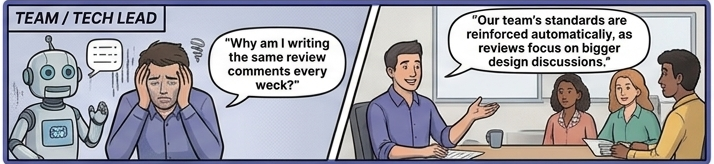
| Team / Tech Lead | Repetitive comments “Why am I writing the same review comments every week?” | Automated standards “Our team's standards are reinforced automatically, so reviews focus on bigger design discussions.” |
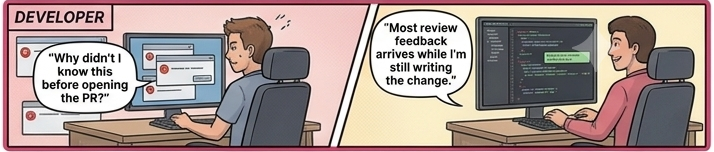
| Developer | Late feedback “Why didn't I know this before opening the PR?” | Earlier feedback “Most review feedback arrives while I'm still writing the change.” |
You're probably asking
Production incidents
“How do we avoid another production incident that affects customers?”
After 14 days you'll say
Fewer incidents
“We're catching more customer-impacting issues before they become incidents.”
You're probably asking
AI quality risk
“AI is making us faster. Is it also making us sloppier?”
After 14 days you'll say
Quality visibility
“I finally have visibility into where quality is improving, and where it isn't.”
You're probably asking
Inconsistent reviews
“Why do different teams review code so differently?”
After 14 days you'll say
Consistent standards
“Our engineering standards are becoming consistent across teams.”
You're probably asking
Late UX issues
“Why do obvious UX or product issues still reach QA?”
After 14 days you'll say
Earlier product checks
“Product expectations are being checked while features are still being built.”
You're probably asking
Late release slips
“Why do releases suddenly slip because of late bugs?”
After 14 days you'll say
Earlier risk visibility
“Engineering risks are visible much earlier in the release cycle.”
You're probably asking
Repetitive comments
“Why am I writing the same review comments every week?”
After 14 days you'll say
Automated standards
“Our team's standards are reinforced automatically, so reviews focus on bigger design discussions.”
You're probably asking
Late feedback
“Why didn't I know this before opening the PR?”
After 14 days you'll say
Earlier feedback
“Most review feedback arrives while I'm still writing the change.”
Measurable outcomes
| Today | After Two Weeks |
|---|---|
✕Repeated comments Senior engineers repeatedly point out the same issues in reviews. | ✓Reinforced standards Routine engineering practices are reinforced automatically, allowing reviewers to focus on architecture and design. |
✕Late bug discovery Bugs are often discovered by QA, or worse, by customers. | ✓Earlier bug discovery More issues are caught while the developer is still working on the change. |
✕Reviewer-dependent quality Engineering quality depends heavily on who reviewed the code. | ✓Consistent quality Teams begin following the same engineering practices regardless of reviewer. |
✕Blind leadership Leadership only hears about quality when something goes wrong. | ✓Early visibility Leadership starts seeing trends before they become production incidents. |
✕Tribal knowledge Team knowledge lives inside experienced engineers' heads. | ✓Shared knowledge Team knowledge becomes part of your everyday development workflow. |
✕Review overload AI increases code output but also increases review pressure. | ✓Balanced AI output AI increases productivity without overwhelming your review process. |
✕Repeated comments
Senior engineers repeatedly point out the same issues in reviews.
✓Reinforced standards
Routine engineering practices are reinforced automatically, allowing reviewers to focus on architecture and design.
✕Late bug discovery
Bugs are often discovered by QA, or worse, by customers.
✓Earlier bug discovery
More issues are caught while the developer is still working on the change.
✕Reviewer-dependent quality
Engineering quality depends heavily on who reviewed the code.
✓Consistent quality
Teams begin following the same engineering practices regardless of reviewer.
✕Blind leadership
Leadership only hears about quality when something goes wrong.
✓Early visibility
Leadership starts seeing trends before they become production incidents.
✕Tribal knowledge
Team knowledge lives inside experienced engineers' heads.
✓Shared knowledge
Team knowledge becomes part of your everyday development workflow.
✕Review overload
AI increases code output but also increases review pressure.
✓Balanced AI output
AI increases productivity without overwhelming your review process.
The 14 days
Every phase below has a hands-on walkthrough, with the screens, commands and checklists your team works through. Open the full plan
Connect your tools
Connecting takes minutes. By day 3, every repo, every commit, and every PR/MR across your whole team is being reviewed, plus scheduled sweeps run across the codebase.
- Your git host, AI provider, Slack/Teams/email, and local tools: all wired in one sitting.
- Commit-level, PR/MR-level, and scheduled reviews running across every repo, for the whole team.







Your team gets into the flow
By day 7, responding to review comments is just part of how your team ships.
- Developers reply to and act on review comments right inside the PR/MR.
- Team starts exploring API/MCP access, different review levels, and custom rules.
- The system starts picking up on your team's patterns and preferences.
Tune it to your team
By day 11, a standards doc your own team leads helped write.
- Customization finalized with the people who own that code.
- One centralized view: every review, every repo, real time.
- Recurring issues start surfacing on their own.
See what we found
By day 14, a report with your org's name on it: top contributors, change volume, issues by category.
- Every issue classified by category: security, performance, reliability, and more.
- Fewer defects reaching your customers means safer, faster, more reliable releases.
Catch issues earlier, ship faster, all without giving up quality.
The result
Business Leadership: Greater confidence that releases won't become customer escalations.
CTO / VP Engineering: Visibility into where quality is improving, and where it still needs attention.
Engineering Manager: Less time spent chasing consistency across teams.
Product Manager: Fewer avoidable issues reaching QA.
Team / Tech Lead: Less time repeating the same review comments.
Developer: Useful feedback while you're still writing the code.
That's engineering confidence: full advantage of AI, without sacrificing quality.
Ready to increase engineering confidence at every level?
Fourteen days from now, your CEO, your CTO, your tech leads, and your developers can all point to something concrete that changed for them.
Not convinced fully?
Understand in detail